

If you have ever fallen down a late-night rabbit hole searching for a name with real depth, you already know how hard it is to find one that feels dark without feeling heavy. You want something moody, poetic, maybe a little mysterious, but still a name a real person could carry through school pickup lines and job interviews alike. That is exactly what this list is for.
Below you will find over 275 Japanese names tied to darkness, night, shadow, and black, sorted by category so you can jump straight to what fits your search. Each name comes with its likely kanji reading and a short meaning so you are not just picking a pretty sound, you are picking something with a story behind it.
Quick Checklist Before Choosing Japanese Names That Mean Dark

Before you scroll through hundreds of options, it helps to know what you are actually looking for.
- Decide on tone first. “Dark” can mean night sky, deep shadow, storm cloud, or literal black. These feel very different in real life.
- Check the kanji, not just the sound. The same sound (say, “yami”) can be written with different characters that carry different meanings, some flattering, some not.
- Say it out loud in context. A name that reads beautifully on a screen can land differently shouted across a playground.
- Ask a native speaker if you can. Meaning and connotation shift by region and generation, and a quick gut-check saves regret later.
- Think about nicknames. Many of these names shorten naturally, so picture the short version too.
- Consider the full name together. A dark-themed first name next to a bright, cheerful surname can actually work beautifully as contrast.
Japanese Names Inspired by Darkness

These are broad, versatile picks built around the core idea of darkness itself.
- Yami (闇) – darkness, often used poetically rather than as a everyday first name
- Ankoku (暗黒) – deep darkness, a strong and dramatic choice
- Kurayami (暗闇) – pitch darkness, more of a descriptive word than a common name
- Anya (杏夜) – a soft blend meaning “apricot night,” gentle despite the dark theme
- Meian (明暗) – literally “light and dark,” a name that carries balance
- Kuroto (黒兎) – “black rabbit,” playful yet shadow-toned
- Yamito (闇人) – “person of darkness,” bold and unusual
- Ankokuji (暗黒児) – “child of darkness,” rare and striking
- Kagemi (影実) – “shadow truth,” thoughtful and layered
- Ankou (暗光) – “dark light,” a quiet contradiction that reads as poetic
- Kurono (黒乃) – a softened black-themed name, gentle on the ear
- Yamine (闇音) – “sound of darkness,” unusual and artistic
- Kokuei (黒影) – “black shadow,” direct and strong
- Ankai (暗海) – “dark sea,” evokes depth and mystery
- Kuroshi (黒司) – “black overseer,” commanding and rare
- Yamika (闇香) – “fragrance of darkness,” delicate and unexpected
- Ankuro (暗黒) – a stylized reading of “deep dark,” modern and edgy
- Meikage (明影) – “bright shadow,” a striking contrast name
- Kuroya (黒夜) – “black night,” simple and memorable
- Yamiko (闇子) – “child of darkness,” softened with the common “ko” ending
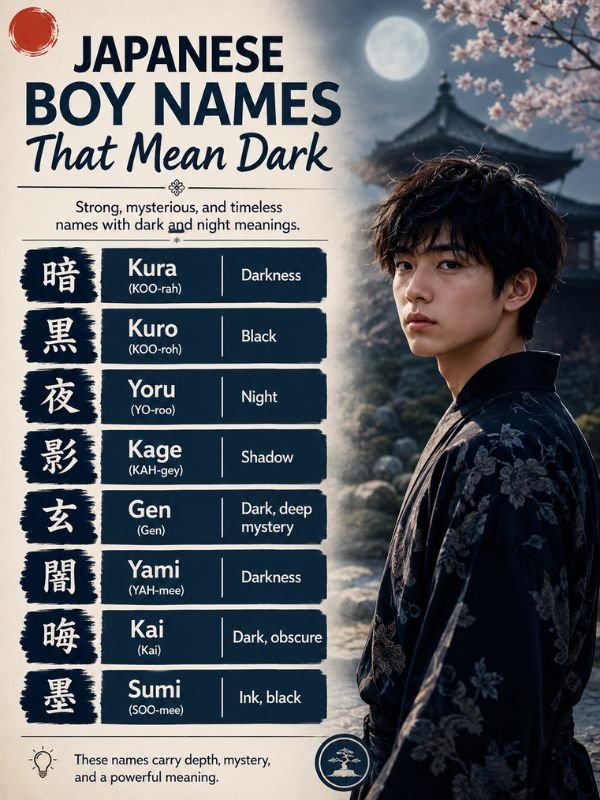
Japanese Boy Names That Mean Dark
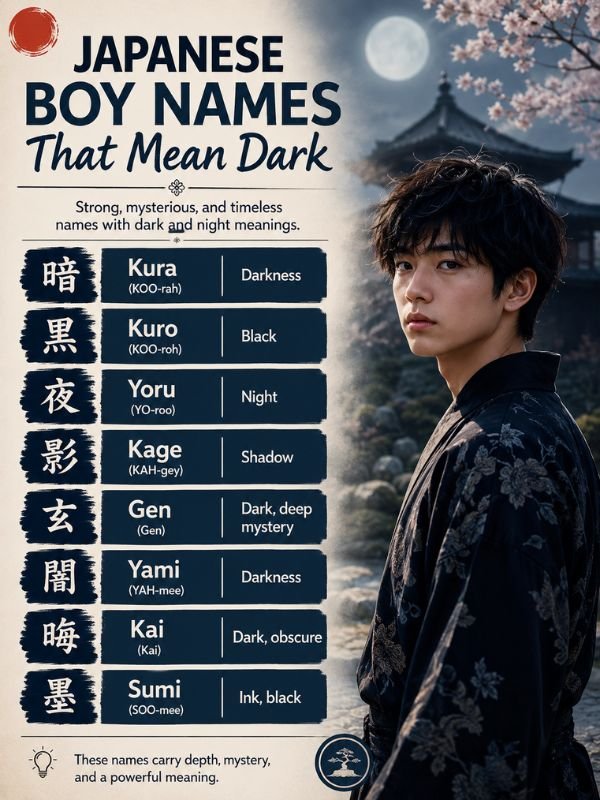
- Kuro (黒) – simply “black,” short, punchy, and easy to say
- Yoru (夜) – “night,” a favorite for its clean sound and clear meaning
- Kage (影) – “shadow,” a strong single-syllable pick
- Ankoku (暗黒) – “deep darkness,” dramatic and rare as a first name
- Kurotaka (黒鷹) – “black hawk,” powerful and nature-linked
- Yamato (闇人) – written this way, “person of darkness” (note: more commonly “大和” means “great harmony,” so double-check kanji if this matters to you)
- Kuroshi (黒士) – “black warrior,” bold and masculine
- Anji (暗司) – “dark overseer,” short and modern
- Kagetora (影虎) – “shadow tiger,” a real historical-style name with serious weight
- Kuromaru (黒丸) – “black circle,” a traditional-sounding boy’s name
- Yorunosuke (夜之助) – “helper of the night,” classic and formal
- Ankou (暗光) – “dark light,” a thoughtful contrast name
- Kagemasa (影正) – “true shadow,” dignified and historical in feel
- Kuroto (黒人) – written this way, “black person” (better as 黒兎 “black rabbit” or 黒斗 “black measure” to avoid confusion)
- Yamikaze (闇風) – “dark wind,” dramatic and nature-inspired
- Kurohiko (黒彦) – “black prince,” traditional and elegant
- Ankai (暗界) – “dark realm,” bold and unusual
- Yorumaru (夜丸) – “night circle,” gentle traditional feel
- Kagenari (影成) – “shadow becoming,” poetic and rare
- Kuroyasu (黒安) – “black peace,” a nice contrast of tone
Japanese Girl Names That Mean Dark or Night

- Yoruka (夜華) – “night flower,” soft and elegant
- Anya (杏夜) – “apricot night,” a gentle blend already popular in translation
- Kagemi (影美) – “beautiful shadow,” delicate and poetic
- Yozora (夜空) – “night sky,” a favorite for its imagery
- Kuroe (黒絵) – “black picture,” artistic and unusual
- Anzu (杏) – “apricot,” often paired with dark themes through kanji like 杏夜
- Yamika (闇花) – “flower of darkness,” striking and rare
- Yorumi (夜美) – “beautiful night,” gentle and easy to say
- Kurono (黒乃) – a soft black-themed name with a classic feminine ending
- Ankana (暗奏) – “dark melody,” artistic and musical
- Yozuki (夜月) – “night moon,” a beautiful, widely loved combination
- Kagerou (陽炎) – technically “heat shimmer,” often mistaken for dark-themed but included here for its shadowy, ephemeral feel
- Yamiko (闇子) – “child of darkness,” softened by the “ko” ending
- Kuronami (黒波) – “black wave,” bold and oceanic
- Anri (暗璃) – “dark glass,” modern and delicate
- Yozora (夜空) – repeated here deliberately as it is genuinely one of the most requested night-sky names
- Kagehana (影花) – “shadow flower,” soft contrast name
- Ankoto (暗琴) – “dark koto (harp),” artistic and traditional
- Yorune (夜音) – “sound of night,” gentle and musical
- Kuroka (黒香) – “black fragrance,” unusual and memorable
Also Read This : 150+ Scottish Baby Girl Names with Meanings (2026 List)
Japanese Names Inspired by Night and Shadows

- Yoru (夜) – “night,” clean and universally understood
- Yozora (夜空) – “night sky,” one of the most beloved night-themed names
- Yofuke (夜更け) – “deep night,” poetic but unusual as a first name
- Kage (影) – “shadow,” strong on its own
- Kagerou (陽炎) – “shimmer of heat,” often grouped with shadow names for its hazy quality
- Yozuki (夜月) – “night moon,” soft and widely liked
- Yoake (夜明け) – technically “dawn,” included here as a meaningful contrast pick for parents who want a night-to-light arc
- Kagenami (影波) – “shadow wave,” rare and evocative
- Yorukaze (夜風) – “night wind,” gentle and atmospheric
- Kagetsuki (影月) – “shadow moon,” poetic and rare
- Yoisora (宵空) – “evening sky,” softer than yozora
- Kagemori (影森) – “shadow forest,” nature-linked and unusual
- Yoiyami (宵闇) – “dusk darkness,” a real, evocative Japanese word
- Kageroi (影恋) – “shadow of longing,” poetic and emotional
- Yozutsumi (夜包) – “wrapped in night,” gentle and unusual
- Kagesumi (影澄) – “clear shadow,” a graceful contrast name
- Yorei (夜麗) – “beautiful night,” elegant and modern
- Kagehiro (影広) – “wide shadow,” dignified and traditional
Rare Japanese Names Associated With Darkness

- Meiya (冥夜) – “underworld night,” dramatic and rarely used
- Yamigami (闇神) – “god of darkness,” reserved for those wanting something mythic
- Kuronoshin (黒之進) – a traditional-style compound name meaning roughly “advance of black”
- Ankokuten (暗黒天) – “dark heaven,” bold and unusual
- Meikoku (冥黒) – “underworld black,” striking and rare
- Yamitora (闇虎) – “dark tiger,” powerful and uncommon
- Kurotsuki (黒月) – “black moon,” poetic and rare
- Ansetsu (暗雪) – “dark snow,” an unusual contrast pairing
- Meikage (冥影) – “underworld shadow,” reserved for a very deliberate choice
- Yamigumo (闇雲) – “dark cloud,” dramatic and nature-based
- Kurohana (黒華) – “black flower,” elegant and rare for a boy or girl
- Ansui (暗水) – “dark water,” calm yet moody
- Meiran (冥嵐) – “underworld storm,” intense and uncommon
- Yamiiro (闇色) – “color of darkness,” modern and abstract
Mythological Japanese Names Inspired by Darkness
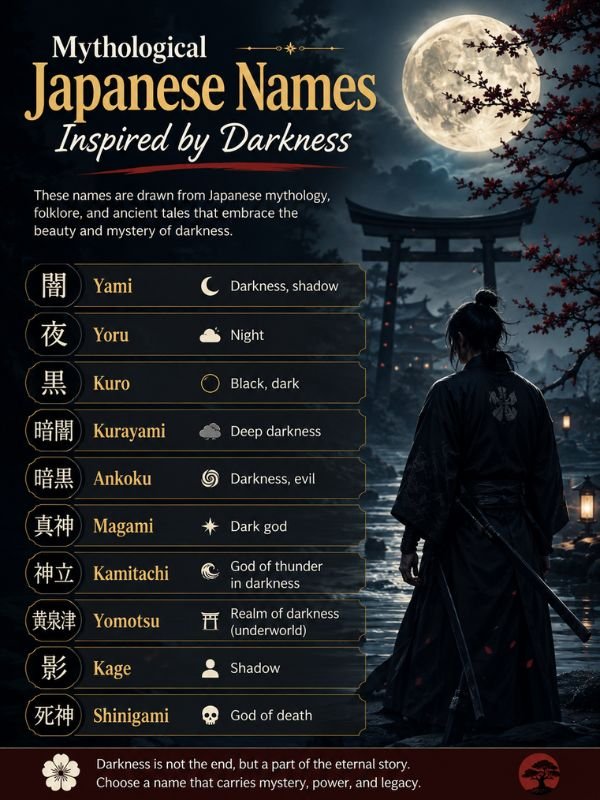
Japanese mythology has genuine ties to darkness, most famously through Yomi, the underworld in Shinto belief, and Izanami, the goddess associated with it after her death.
- Yomi (黄泉) – the name of the underworld itself, powerful and steeped in real mythology
- Izanami (伊弉冉) – the goddess linked to death and the underworld in the Kojiki
- Susanoo (須佐之男) – the storm god, not directly “dark” but tied to chaos and night in folklore
- Tsukuyomi (月読) – the moon god, a strong pick for night-themed meaning
- Yamata (八岐) – referencing Yamata no Orochi, the eight-headed dragon of darkness and destruction
- Amanojaku (天邪鬼) – a mischievous, shadow-linked spirit from folklore
- Kuraokami (闇龗) – a rain and water deity whose name literally contains “kura,” meaning dark
- Yatagarasu (八咫烏) – the three-legged crow guide, associated with the space between light and dark
- Nue (鵺) – a chimeric night creature from Japanese legend
- Ohaguro-bettari (お歯黒べったり) – a lesser-known yokai tied to darkness and mystery, more novelty than practical name
Nature-Inspired Japanese Names That Mean Dark
- Kuroiwa (黒岩) – “black rock,” grounded and strong
- Yamikawa (闇川) – “dark river,” flowing and moody
- Kuroki (黒木) – “black tree,” an existing real-world Japanese surname turned first name
- Ansora (暗空) – “dark sky,” dramatic and simple
- Kuromori (黒森) – “black forest,” bold and nature-rooted
- Yamizora (闇空) – “dark sky,” stronger and more literal than ansora
- Kurokawa (黒川) – “black river,” another real surname with strong nature ties
- Ansan (暗山) – “dark mountain,” rare and grounded
- Kuroumi (黒海) – “black sea,” bold and oceanic
- Yamiyama (闇山) – “dark mountain,” dramatic and rare
- Kurotsuchi (黒土) – “black earth,” grounded and unusual
- Anrin (暗林) – “dark forest,” soft and nature-linked
Modern Japanese Names With a Dark Aesthetic

- Kuro (黒) – minimalist, striking, works well internationally
- Rin (凛) – not literally “dark,” but often chosen for its cool, sharp aesthetic that pairs well with dark themes
- Yami (闇) – direct, bold, popular in fiction and increasingly in real naming circles
- Kai (魁) – not dark by meaning, but a modern favorite often styled alongside dark-toned names
- Shion (紫音) – “purple sound,” frequently chosen for its moody, modern feel
- Ren (連) – modern and gender-neutral, often paired with dark-themed middle names
- Sora (空) – “sky,” used often as a softening contrast to a dark-themed sibling name
- Yoru (夜) – clean, modern, and increasingly popular outside Japan too
Japanese Names Inspired by Black
- Kuro (黒) – the most direct translation of “black”
- Kuroi (黒い) – the adjective form, used stylistically as a name
- Kuronosuke (黒之助) – traditional-style, “helper of black”
- Kurohime (黒姫) – “black princess,” elegant and historical in tone
- Kuroshi (黒司) – “black overseer,” commanding
- Kurono (黒乃) – soft and modern
- Kurotarou (黒太郎) – a classic-style boy’s name built on “kuro”
- Kuroko (黒子) – “black child,” also a known theatrical term for a stagehand dressed in black
- Kurohana (黒華) – “black flower”
- Kurosawa (黒沢) – technically a surname meaning “black swamp,” included for those drawn to its cultural weight
How We Create Japanese Names That Mean Dark
Every name on this list was chosen using three checks: the kanji has to actually carry a dark, night, shadow, or black meaning, the reading has to be plausible as a real Japanese name or name-style word, and the overall tone has to fit how these names are actually used in Japan today, whether in daily life, historical records, or folklore.
Where a name is more poetic than common (like many of the “rare” and “mythological” picks), we have said so directly instead of pretending every entry belongs on a birth certificate. That honesty matters more than hitting a round number.
Tips for Choosing the Perfect Japanese Dark Name
- Match the meaning to the feeling you want, not just the sound. “Shadow” and “night” read very differently from “underworld.”
- Test it with a middle name or surname to make sure the rhythm works.
- Look up the kanji before you commit. A single character swap can change “dark and mysterious” into something unintended.
- Consider how the name ages. A dramatic mythological name can suit an adult very differently than it suits a toddler.
- Ask about pronunciation stress, since English speakers often flatten the natural rhythm of Japanese names.
Also Read This :Japanese Names Starting with S: 170+ Picks for Boys, Girls
Personalization Tips
- Pair a bold dark-themed first name with a soft, light-themed middle name for balance, such as Yami paired with a middle name meaning “hope” or “dawn.”
- If you are naming a pet, project, or username rather than a child, you have more freedom to lean into the dramatic mythological picks.
- For twins or siblings, consider a light and dark theme pair, like Yozora (“night sky”) and Asahi (“morning sun”).
When to Choose Each Category
- Go with “Names Inspired by Darkness” or “Black” if you want something simple, strong, and easy for most people to say correctly.
- Choose “Night and Shadow” names if you want imagery over bluntness, something softer that still carries the theme.
- Reach for “Rare” or “Mythological” names if you are naming a creative project, a character, or want a genuinely unique real-world name and are prepared to explain its meaning often.
- Pick “Nature-Inspired” or “Modern” options if you want the dark theme to feel grounded and wearable in everyday life.
Frequently Asked Questions
What Japanese name means dark?
Yami is the most common Japanese word for dark, and it’s often used as a striking name on its own.
Is Kuro a boy or girl name?
Kuro (meaning black) is mostly used for boys, though it also shows up as a nickname or middle name for either gender.
What does Yoru mean in Japanese?
Yoru means night, and it’s a soft, poetic name that suits both boys and girls.
Are there Japanese girl names that mean dark or night?
Yes, An’ya (dark night) and Kage (shadow) are popular picks for girls with a dark, mysterious feel.
What kanji is used for “dark” in Japanese names?
闇 (yami) means darkness, 黒 (kuro) means black, and 影 (kage) means shadow, each giving a different tone.
Do dark-meaning Japanese names have a negative meaning?
Not usually, they’re linked to mystery and calm rather than anything bad, which is why they’re popular in anime.
What’s a unique Japanese name that means dark?
Kurayami is a rare, striking choice that literally means darkness and isn’t commonly used as a first name.
Conclusion
Choosing a name tied to darkness, night, or shadow does not have to mean choosing something bleak. Many of the names above lean poetic rather than heavy, and pairing the right kanji with the right sound can turn a “dark” name into something that feels striking instead of somber.
Whatever direction you go, take the time to check the kanji and say the name out loud a few times before you settle on it. If one of these caught your eye, or if you ended up combining two into something new, drop it in the comments. We would genuinely like to see what you land on.
