

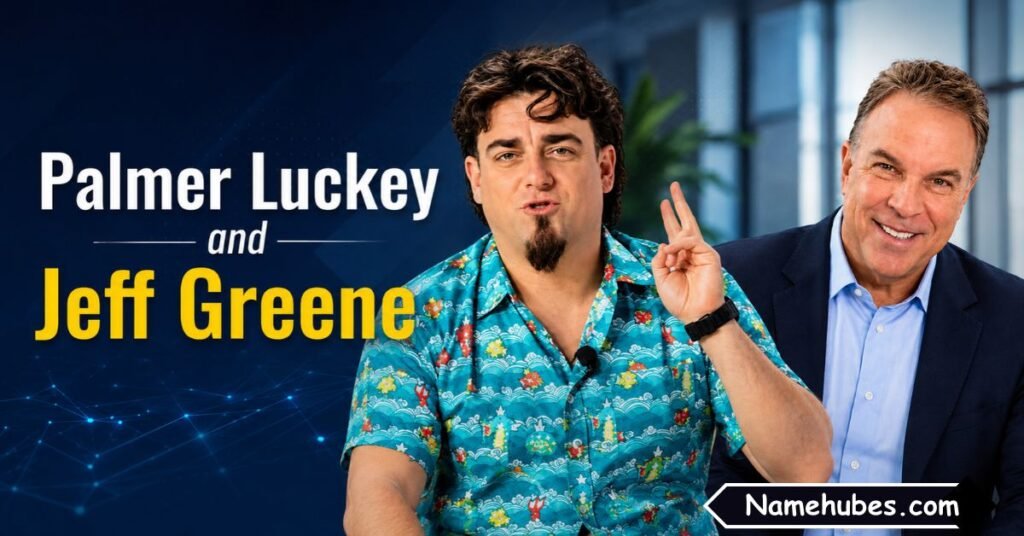
Two American entrepreneurs, two very different fortunes. Palmer Luckey and Jeff Greene often show up in the same searches. Here’s what the public record actually shows. One built virtual-reality hardware and then a defense technology company. The other made his money in real estate and a famous bet against subprime mortgage bonds.
Their paths never overlap in any documented way. Still, comparing them shows how technology, property, and financial markets can each produce serious wealth. You’ll learn about their early lives, education, major deals, and public activities. You’ll also get clear answers on whether they’re related, whether Luckey is a billionaire, and how each man earned his reputation in business.
Quick Bio: Palmer Luckey and Jeff Greene
| Detail | Palmer Luckey | Jeff Greene |
| Full name | Palmer Freeman Luckey | Jeff Greene |
| Nationality | American | American |
| Profession | Inventor, entrepreneur, technology founder | Real estate investor and entrepreneur |
| Known for | Oculus VR and Anduril Industries | Real estate investments and financial-market strategies |
| Major industries | Virtual reality, artificial intelligence, defense technology | Real estate, finance, property development |
| Major milestone | Facebook’s 2014 acquisition of Oculus VR | Profiting from the subprime mortgage crisis |
| Education | Golden West College, Long Beach City College, California State University, Long Beach | Johns Hopkins University and Harvard Business School |
| Business approach | Building and developing technology companies | Acquiring property and investing in financial markets |
Who Is Palmer Luckey?
Palmer Luckey is an American inventor and entrepreneur who helped bring modern virtual reality to a mainstream audience. He became internationally known for the Oculus Rift, a virtual-reality headset built to deliver an immersive digital experience. Game developers, investors, and major technology companies all noticed his early work.
His story shows how tinkering can turn into a business. Luckey didn’t start inside a large tech corporation. He pursued electronics and virtual reality through independent projects. Those experiments produced an early headset that people took seriously.
Then his career took a sharp turn. After the sale of Oculus VR, he founded Anduril Industries, a company focused on defense technology, autonomous systems, sensors, and artificial intelligence. The move linked his hardware and software experience with a sector long dominated by established defense contractors.
Palmer Luckey’s Early Life and Interest in Technology
Palmer Luckey grew up in Long Beach, California. Computers, electronics, and video games filled much of his time. He liked taking hardware apart and modifying it to squeeze out better performance. Picture a teenager swapping parts in a gaming PC just to see what happens. Luckey took that habit much further.
Virtual reality had a long history before he arrived. Researchers and companies had tested head-mounted displays, motion tracking, and computer-generated environments for decades. Most products cost too much, felt uncomfortable, or suffered from weak displays and limited processing power. Luckey wondered whether affordable components could deliver a better experience.
He started building and modifying headsets from parts available to independent developers. Those projects taught him how display resolution, field of view, latency, and motion tracking shape immersion. A headset isn’t just a screen strapped to your face. Each of those factors changes how convincing and comfortable a virtual world feels.
Luckey also started college early. He attended Golden West College and Long Beach City College before moving on to California State University, Long Beach. He eventually left to focus on Oculus VR. For him, a growing business opportunity mattered more than the traditional academic route.
How Oculus VR Made Palmer Luckey a Technology Entrepreneur
In 2012, Luckey founded Oculus VR and introduced the Oculus Rift development project. Gaming fans and developers who wanted a more immersive way to experience digital worlds quickly took notice. A crowdfunding campaign showed that real demand existed. Later investment paid for further development.
Oculus became a leading name in the revival of consumer virtual reality. The company worked on headset hardware, developer support, and the software ecosystem that interactive experiences need. Its progress pushed game studios and technology companies to treat VR as a serious platform for entertainment, communication, simulation, and training.
The defining moment arrived in 2014 when Facebook acquired Oculus VR. The deal was announced at roughly $2 billion. Some accounts put the figure near $2.3 billion once additional considerations are included. The purchase reflected Facebook’s belief that immersive computing would shape future digital life.
The acquisition gave Oculus access to huge resources. It also made Luckey one of tech’s most visible young entrepreneurs. An independent inventor had built something that a major corporation wanted.
Still, a big acquisition doesn’t make a product universal overnight. Cost, comfort, processing demands, software availability, and the need for compelling experiences all slowed adoption. Even so, Oculus accelerated investment and competition across the industry. That helped consumer virtual reality grow.
Why Palmer Luckey Founded Anduril Industries
Luckey’s career shifted in 2017 when he left Facebook and founded Anduril Industries with a group of co-founders. The company builds technology for defense and national security. That includes autonomous systems, surveillance equipment, sensors, and software that helps operators make sense of complex environments.
His interest in defense grew partly from earlier exposure to research linking virtual reality with military uses. He saw a chance to apply modern computing, software, and hardware design to national security problems. His consumer-tech background also shaped a belief that some defense systems could benefit from faster development cycles and tighter software integration.
Anduril doesn’t operate like a traditional defense contractor. It combines hardware, software, sensors, and artificial intelligence into connected systems rather than isolated products. The equipment is meant to share information and support coordinated operations.
Its portfolio has included autonomous aerial systems, underwater vehicles, and surveillance platforms. Those tools target jobs such as monitoring large areas, collecting information, spotting potential threats, and supporting military operations. Real-world performance depends on the product and the conditions where it’s used.
Anduril’s rise has also sparked debate. Supporters say newer companies bring faster innovation and modern capabilities. Critics raise questions about autonomous weapons, surveillance, accountability, and the limits of artificial intelligence in warfare. Those arguments now sit at the center of Luckey’s professional identity. His work has moved well beyond gaming hardware into national security, public procurement, and ethics.
Is Palmer Luckey a Billionaire? Exploring His Wealth and Business Success
Most credible estimates say yes. Forbes put his net worth at about $3.5 billion in early 2026. Other websites publish figures that run far lower or far higher, so treat any single number with caution.
Two sources explain nearly all of that wealth. The first is the Oculus sale to Facebook in 2014, worth roughly $2 billion at announcement. The second is his founder’s stake in Anduril Industries, which carries the bigger upside. A 2025 funding round valued Anduril at about $30 billion. Reports in early 2026 pointed to a new round near $60 billion.
Here’s the catch. Anduril is privately held. Nobody outside the company knows exactly how much of it Luckey owns or what that stake would fetch in a sale. That’s why estimates vary so much. A valuation also isn’t cash in the bank.
His business success comes down to a repeatable pattern: spot an emerging market, then build a company around it. He did that with consumer virtual reality. He did it again with defense technology.
Is Palmer Luckey Associated With Peter Thiel?
Yes, through business. Peter Thiel’s venture firm, Founders Fund, has invested in Anduril Industries. Local business reporting in 2026 also described Luckey and Thiel teaming up on a fresh push for the company.
That link is professional rather than personal. Investors back founders all the time. The relationship fits that familiar pattern. It doesn’t mean Thiel co-founded the company or runs it.
It also doesn’t connect Luckey to Jeff Greene in any way. Thiel has no documented role in Greene’s real estate career.
Who Is Jeff Greene?
Jeff Greene is an American real estate investor and entrepreneur. His wealth grew through property deals and financial-market decisions. Luckey started with technology. Greene started with assets, risk, and timing.
Greene grew up in Worcester, Massachusetts. As a young man he worked a range of jobs and leaned on financial aid and other resources to pay for school. Profiles often highlight that start because it contrasts so sharply with the investment portfolio he built later.
He attended Johns Hopkins University and then earned an MBA from Harvard Business School. School gave him a foundation in business and finance. Still, his results also came from practical choices about borrowing, ownership, and entering markets when sentiment shifted.
At Harvard he began buying residential property. Instead of treating housing as a pure expense, he considered buying a place, living in part of it, and renting out the rest. The rent could offset his costs while he built an asset. By the time he finished his MBA, he reportedly owned 18 properties.
How Jeff Greene Built His Wealth Through Real Estate Investments
Real estate sits at the core of Greene’s career. He moved from early residential deals into larger and more complex projects. His interests have included apartment buildings, condominiums, hotels, and other developments, especially in South Florida and Los Angeles.
Property can pay off in several ways. Owners collect rental income, benefit from property appreciation, improve a building and sell it for more, or borrow to expand a real estate portfolio. Each route carries its own risks. Interest rates, local demand, construction costs, and financing terms all matter.
Greene’s story also shows why investors have to adapt. A portfolio that thrives in a boom can struggle when borrowing gets pricier or demand fades. Rental income has to cover costs. Owners must meet their obligations during a downturn.
He felt that pressure during the property-market weakness of the 1990s. Prices can drop while financing costs and operating expenses keep rolling in. His ability to stay active and chase later opportunities became part of his investing record.
Greene didn’t rely only on buying and holding buildings. He also became known for financial-market investments. That leads straight to his most famous move.
How Jeff Greene Profited During the 2008 Financial Crisis
In the years before 2008, the United States went through a housing boom. Lenders handed out loans freely. Some borrowers struggled to repay them. Banks packaged mortgages into securities and sold those products to investors.
As prices climbed, many people assumed values would hold and losses would stay small. Then housing prices fell and defaults rose. Weak spots in the mortgage market became obvious. Institutions holding mortgage-related assets took heavy losses.
Greene bet against certain subprime mortgage-backed securities by buying credit default swaps. These contracts can protect a holder against a defined credit event. Investors can also use them to profit when they expect a debt instrument to lose value.
As the housing market deteriorated and subprime risks grew, his position paid off. Forbes reported a windfall of about $800 million. That gain became a turning point in his financial history.
Don’t mistake it for a routine return. Credit default swaps are complex. Their value depends on contract terms, counterparties, market pricing, and timing. An investor who tries a similar trade without sound analysis or deep reserves can lose a fortune.
The trade also shows the gap between seeing a risk and profiting from it. You can spot a problem early and still lose money if your timing is off or the position costs too much. Greene’s assessment of the housing market happened to line up with the collapse. After that win, he steered significant resources into property and other investments.
Jeff Greene’s Public Life, Political Activities, and Philanthropy
Greene’s profile reaches well beyond real estate. In 2010, he ran for the Democratic nomination for the U.S. Senate in Florida. In 2018, he sought the Democratic nomination for governor. He didn’t win either race. The campaigns did put his background and business career in front of many more people.
Running for office is part of his public biography. It isn’t a source of his wealth. It also doesn’t prove anything about how effective his proposed policies would have been.
He also supports education through the Greene School in Palm Beach, Florida, which he established with his wife. The school serves students with strong academic potential. A school is a long-term commitment. That sets it apart from a one-time donation.
Philanthropy takes many forms. Think direct gifts, new institutions, research funding, and educational opportunities. Investing, politics, and giving are separate activities, so each deserves its own evaluation.
Palmer Luckey and Jeff Greene: Comparing Their Careers and Achievements
| Area | Palmer Luckey | Jeff Greene |
| Starting point | Building headsets and testing hardware | Buying residential property during business school |
| Core skill | Product development and engineering | Capital allocation and financial risk assessment |
| Main wealth drivers | Oculus sale to Facebook and his Anduril stake | Real estate portfolio and credit default swap windfall |
| Main risks | Technological, regulatory, and commercial | Property-market cycles, financing, and market swings |
| Public profile beyond business | Defense technology debates | Politics and education |
Are Palmer Luckey and Jeff Greene Related or Business Partners?
Plenty of people search for the pair together and wonder about a family tie or a shared company. The public record doesn’t show either. Luckey is known for Oculus VR and Anduril Industries. Greene is known for real estate investing and his position during the subprime mortgage crisis. Their businesses sit in different parts of the economy.
Without reliable reporting or an official statement, calling them relatives, partners, or collaborators would be inaccurate. Search results can pair two names for many reasons. Readers may want a comparison. Another website may have grouped them. Some people just want to know who each man is.
A shared search phrase isn’t proof of a personal relationship. It only shows that both men are prominent in discussions of American entrepreneurship and wealth.
What Makes Palmer Luckey and Jeff Greene Different as Entrepreneurs?
Their careers point to two distinct routes. One creates technology that solves a problem or opens a new market. The other hunts for assets or financial opportunities that are undervalued, mispriced, or set to gain from changing conditions.
Luckey’s path stresses experimentation, technical development, and commercial execution. Oculus attracted a major acquisition. Anduril launched a new enterprise in defense technology. Both needed more than a clever idea. They required turning concepts into products and building organizations that could deliver them.
Greene’s path mixes gradual asset building with concentrated financial bets. Early property purchases created a base. His position against subprime mortgage-backed bonds then became a major source of wealth. His story also shows why downside risk deserves as much attention as potential gains.
Neither story is a guaranteed formula. Luckey benefited from specific technology conditions and strong market interest. Greene’s outcomes depended on particular property opportunities and unusual conditions in credit markets. Different circumstances could have produced very different results.
The real lesson is simpler. Research, risk assessment, adaptability, and execution matter far more than any single strategy.
Frequently Asked Questions About Palmer Luckey and Jeff Greene
Here are quick answers to the questions readers ask most.
Who Is Palmer Luckey Related To?
Luckey was born in Long Beach, California, where he grew up with three younger sisters. He is married to Nicole Luckey. Public details about his extended family are limited. No reliable source shows a family link between Luckey and Jeff Greene.
Is Palmer Luckey a Billionaire?
Most credible estimates say yes. Forbes valued his net worth at around $3.5 billion in early 2026. Because Anduril is privately held, the exact figure stays uncertain.
Is Palmer Luckey Associated With Peter Thiel?
Yes, as a business matter. Thiel’s firm, Founders Fund, has invested in Anduril Industries. Thiel isn’t listed among the company’s founders. Nothing in the public record points to a family connection.
How Did Palmer Luckey Get So Rich?
Two ventures did the heavy lifting. He founded Oculus VR and sold it to Facebook in 2014 for roughly $2 billion at announcement. He then founded Anduril Industries in 2017, and investors now value it in the tens of billions of dollars. His founder’s stake in Anduril likely accounts for most of his current wealth.
Conclusion
Palmer Luckey and Jeff Greene built their fortunes through very different paths. Luckey became famous for developing Oculus VR and founding Anduril Industries, taking his career from virtual reality into defense technology. His success reflects innovation, engineering, and company building.
Jeff Greene made his wealth through real estate investments and a profitable bet against subprime mortgage-backed securities before the 2008 financial crisis. His career also includes politics and philanthropy. Although their names appear together online, there’s no documented family or business connection between them. Their stories show two distinct approaches to entrepreneurship, wealth, and long-term success.
Related Posts
- Denika Kisty: Her Life, Career, and Marriage to Jason Williams
- Anne Steves: Her Marriage to Rick Steves and Life Today
- Jessica Chastain and Mike Krieger: Their Connection Explained
- Kelly Anne Welbes Abagnale: Wife, Family and Private Life
- Harvey Steinberg Net Worth: What His Legal Career Reveals
- David Lawler and Bruce Broussard: Careers and Key Facts
