

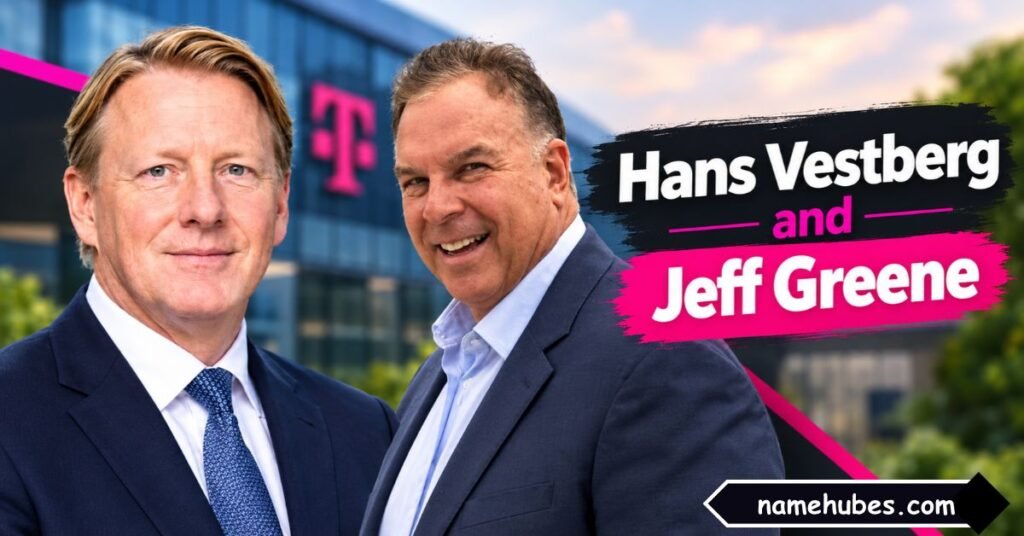
Hans Vestberg and Jeff Greene are two business figures who gained influence through very different paths. Vestberg rose through the telecommunications industry, moving from Ericsson to lead Verizon Communications for eight years. Greene built his reputation in property investment and became known for a bold bet against the US housing market before the 2008 financial crisis.
This guide explains who each man is, what each achieved, how their careers compare, and what business readers can learn from both. It also clears up common confusion, including a television character who shares Greene’s name, and updates Vestberg’s status, since he is no longer Verizon’s chief executive.
Who Is Hans Vestberg?
Hans Vestberg is a Swedish business executive best known for leading Verizon, one of the largest wireless carriers in the United States. He built most of his career in telecommunications, an industry that designs and runs the networks that carry phone calls, internet traffic, and data. His background explains why he was chosen to lead a major American company, and why his decisions focused heavily on network infrastructure.
Early Life and Professional Background
Vestberg studied business administration and economics at Uppsala University, a public research university in Sweden founded in 1477 and one of the oldest universities in Scandinavia. That training gave him a base in finance and organizational management, which later mattered in senior roles at large technology companies. Unlike many executives who start in sales or engineering, his early education focused on how companies make money and allocate resources.
His career developed during the rise of mobile communications, when phone networks were shifting from voice calls to fast mobile data. Telecom companies needed leaders who understood both the engineering behind networks and the business side of selling them. Vestberg’s career sat at that intersection, which is one reason his later work centered on network investment rather than only on consumer products.
Career at Ericsson Before Joining Verizon
Before Verizon, Vestberg spent most of his professional life at Ericsson, a Swedish company founded in 1876 that makes telecommunications equipment, including the base stations and network software used by mobile carriers. Working at a network equipment maker gave him a view of the industry from the supplier side, and the steps below show how he moved up.
The following steps outline his rise at the company:
- He joined Ericsson in 1991. He started in a role that let him learn the company’s operations and finances from the inside.
- He took on wider responsibilities. Over time he gained experience in financial management, regional operations, and international business strategy.
- He became president and chief executive officer in 2010. The role placed him in charge of the company’s direction during a period when network operators were investing heavily in mobile broadband, which is high-speed internet delivered over wireless networks.
His Ericsson years shaped how he approached Verizon. He had already managed customers in markets with different economic conditions and technology needs, so the scale and competition of the US market were familiar to him.
Hans Vestberg’s Leadership at Verizon
Vestberg’s leadership of Verizon is the main reason he is widely known in business circles. His tenure covered a period when wireless carriers spent billions on new spectrum and network upgrades. Those choices defined both the company’s strengths and its criticisms.
Becoming CEO and Shaping Verizon’s 5G Strategy
Vestberg joined Verizon in 2017 and became chief executive in August 2018. His appointment reflected a need to strengthen the company’s wireless position as customers expected faster speeds and more reliable coverage. Verizon’s job was to keep existing customers satisfied while building the infrastructure for the next generation of wireless technology.
The biggest theme of his leadership was 5G, the fifth generation of mobile networks. 5G is designed to offer faster data speeds, more network capacity, and lower delay in data transfer, which supports applications like connected devices and remote monitoring. Spectrum, the radio frequencies that carriers license to send wireless signals, is a central part of this effort.
Verizon’s most significant move was a purchase of C-Band spectrum in 2021 for about $52 billion, one of the largest spectrum investments in the company’s history. Such purchases are expensive, but they give a carrier the airwaves it needs to build a national network.
The following table summarizes key milestones in Vestberg’s Verizon career:
| Milestone | What It Meant for Verizon |
| Joined Verizon in 2017 | Brought his telecom and international experience into the company’s leadership |
| Became CEO in August 2018 | Set the strategic direction for wireless and network investment |
| C-Band spectrum purchase in 2021 | Secured airwaves needed for a national 5G network |
| Frontier Communications acquisition | Added fiber internet infrastructure, with a deal valued at about $20 billion |
| Successor announced in early October | Ended his tenure as CEO and moved him into an advisory role |
Major Achievements, Challenges, and Business Performance

Vestberg’s main achievement was guiding Verizon through the buildout of its 5G network while keeping the company among the country’s largest carriers. Verizon is the largest US carrier by number of customers, which gave it the scale to pursue expensive network projects. The Frontier deal, which added fiber-optic internet to the company’s portfolio, also expanded its ability to offer home broadband alongside mobile service.
The challenges were significant. Industry reporting described Verizon as having lagged competitors in customer sign-ups and as having lost customers for consecutive quarters at one point during his tenure. Commentary in the trade publication Fierce Network also argued that Verizon’s network reputation had weakened as rival T-Mobile gained ground, with Verizon’s share price falling while T-Mobile’s rose sharply over the same period. That commentary is an opinion, but it reflects a real debate about whether Verizon’s investments produced the results shareholders expected.
Vestberg’s record therefore contains both large achievements and visible setbacks. Investments in spectrum and fiber are slow to pay off, and rivals can win customers with pricing and marketing while the infrastructure work continues in the background.
Was Hans Vestberg a Good CEO of Verizon?
Judging a chief executive requires a clear set of standards. Some people focus on financial results, while others focus on network quality, customer satisfaction, or long-term investment. Vestberg’s record looks different depending on which measure you use.
Leadership Decisions and Company Performance
Business analysts usually judge a telecom CEO by a few core measures. Each one tells a different part of the story, so it helps to review them together. The list below shows the main ways to evaluate his leadership:
- Network investment: Verizon committed heavily to spectrum and 5G, which supports long-term capacity but requires large upfront spending.
- Customer growth: Verizon lost customers in some periods and struggled to match rivals’ sign-up numbers, which weighs against its performance.
- Shareholder returns: Verizon’s share price declined during his tenure, while competitors’ shares grew faster, making investor sentiment a major criticism.
- Network reputation: Verizon had long been seen as a leader on network quality, but that reputation became harder to defend as competitors improved.
Each measure supports a different conclusion. A supporter could argue that Vestberg built the infrastructure needed for future growth and that short-term results do not capture the value of that work. A critic could argue that the company failed to convert its investments into customer gains and stock performance. Both views rely on real evidence, so the fairest answer depends on how much weight a reader gives to long-term infrastructure versus near-term results.
Public Reputation and Executive Legacy
Vestberg’s reputation rests on his long technology career and his role in steering a major carrier through a difficult competitive period. He was known as a leader with international experience who had worked in both Sweden and the United States. His time at the top of Verizon also shows how much public attention a major telecom company receives, since its pricing, network performance, and leadership changes are closely followed by investors, regulators, and customers.
His departure marked the end of an era for the company. When Verizon named a successor, Vestberg acknowledged the eight years he had spent with the company’s teams and networks. His legacy will likely be judged by whether Verizon’s 5G and fiber investments eventually produce the growth the company promised, and by how the next leadership team builds on that foundation.
Who Is Jeff Greene?
Jeff Greene is an American real estate investor and entrepreneur based in Palm Beach, Florida. He is known for property investments, a famous bet against the housing market before the 2008 financial crisis, and a public profile as one of the wealthiest figures in South Florida real estate. His career is a useful contrast to Vestberg’s, because it shows how a person can build wealth and influence without running a large public company.
Early Background and Business Career
Greene was born in 1954 in Worcester, Massachusetts. His early years were modest, and he later described working in service jobs in Palm Beach, including as a waiter and busboy at The Breakers, a historic luxury hotel in Palm Beach. That exposure to the area’s wealthy property owners later shaped his career path.
Greene’s early career built on property knowledge he gathered step by step. Industry profiles describe him acquiring a number of properties early on and building a meaningful net worth before he reached business school. After business school, he moved to Los Angeles, where he worked in real estate during a volatile period for property markets. That experience taught him how quickly prices can shift and how important timing is for investors.
Key stages in Greene’s career include:
- Early life in Massachusetts: Born in 1954 in Worcester, where he attended high school.
- Service jobs in Palm Beach: Worked at a historic hotel, which gave him early exposure to the local property market.
- Property acquisitions: Built a portfolio of properties before completing business school.
- Move to Los Angeles: Worked in real estate in a fast-changing market.
- Return to Florida: Built a major presence in Palm Beach and South Florida property development.
Real Estate Investments and Major Business Ventures

Greene’s most famous move was his bet against the US housing market in the years before 2008. Investors who bet against an asset profit when its price falls. Greene took positions that paid off when the subprime mortgage market collapsed. Subprime mortgages are home loans made to borrowers with weaker credit, and mortgage-backed securities are bonds built from bundles of such loans. When many of those loans defaulted, the value of those securities fell sharply. The Real Deal, a real estate trade publication, reports that Greene made hundreds of millions of dollars from this trade.
His real estate activity extends beyond that bet. He has been active in property development in Palm Beach and in downtown West Palm Beach, where he has competed with other local property magnates. Development in a market like this involves buying land, securing financing, managing construction, and deciding whether to sell or hold. Each step carries risk, especially when interest rates or local demand change.
Greene also ran for public office. He campaigned in the Democratic primary for Florida governor, promising to spend heavily on his campaign, but he did not win the nomination. The campaign raised his public profile, and it also showed how wealthy investors can enter politics.
Is Jeff Greene a Billionaire?
Yes, most reporting describes Jeff Greene as a billionaire. Coverage from the Palm Beach Post and industry publications refers to him as a Florida real estate billionaire, and his profile is closely tied to large-scale property holdings. The exact size of his fortune is harder to pin down, because it depends on the value of private property, businesses, and investments that are not publicly traded.
Sources of His Wealth and Real Estate Investments
Greene’s wealth comes from several sources. Each one contributes differently to his net worth, and some are one-time gains while others recur over time. The following list summarizes the main sources:
- The subprime bet: A large one-time gain from positions taken before the 2008 crisis, which provided capital for later investments.
- Real estate holdings: Property he owns and develops in Palm Beach and elsewhere in Florida, which can rise in value over time.
- Rental income: Recurring income from properties that are leased to tenants.
- Business interests: Stakes in companies and ventures beyond direct property ownership.
Net worth estimates for Greene vary widely. Greene himself said during his governor campaign that he was worth about $3.3 billion, which the Orlando Weekly reported. Wealth websites have published figures ranging from about $3.5 billion to $7.8 billion. The table below shows how different sources compare:
| Source | Reported Net Worth | Notes |
| Greene’s campaign statement | About $3.3 billion | Self-reported figure during his Florida governor campaign |
| Bisnow industry listing | About $3.6 billion | Older real estate industry ranking |
| Celebrity Net Worth | About $7 billion | Estimate from a celebrity wealth website |
| Wealth site citing Forbes | About $4.5 billion | I could not confirm this figure directly with Forbes |
What Is Jeff Greene’s Connection to Larry David?
The name Jeff Greene is also famous because of a television character. Jeff Greene is the best friend and manager of Larry David on HBO’s comedy series Curb Your Enthusiasm, which ran from 1999 to 2024. David co-created the show, which follows a fictionalized version of himself through everyday social situations. The character Jeff Greene was played by comedian Jeff Garlin, who also worked as an executive producer on the series.
I found no reliable source that links the real estate investor Jeff Greene to the television character or to David. The shared name appears to be a coincidence. Readers searching for information about the investor often land on articles about the show, and the reverse also happens. A few points help separate the two:
- The television character is a fictional role played by an actor.
- The real estate investor is a Palm Beach property figure with his own business record.
- Searches for either name can return results about the other, so checking the context is important.
Are Hans Vestberg and Jeff Greene Connected?
Based on the sources I reviewed, Hans Vestberg and Jeff Greene have no known professional or personal connection. They are linked only because they are often discussed together as examples of business success in different fields. Their careers can be compared directly, however, because both involve large financial decisions, long-term planning, and public visibility.
Their Different Industries and Professional Paths
Vestberg and Greene operated in separate worlds. Vestberg managed a large company with thousands of employees, shareholders, and customers. Greene built wealth through property deals and investments. The comparison below shows the main differences:
| Area | Hans Vestberg | Jeff Greene |
| Industry | Telecommunications and technology | Real estate investment and development |
| Core role | Chief executive leading a large public company | Investor and developer running private ventures |
| Main decisions | Network investment, spectrum purchases, acquisitions | Property purchases, development, timing of sales |
| Key risk | Competition and customer loyalty | Market cycles, financing costs, property values |
| Public profile | Corporate leader covered by business media | Wealthy investor with political and media exposure |
| Discover More Celebrities |
| Richard Liu and Serena Williams: The Truth Behind Their Link |
| Chris Potoski Net Worth 2026: Business, Family & Career |
| Anne Steves: Her Marriage to Rick Steves and Life Today |
Did Hans Vestberg Step Down as Verizon CEO?
Yes. Verizon announced in early October that Dan Schulman, a former chief executive of PayPal, would become its new CEO. Vestberg stepped down from the role, which he had held since 2018. He was given a special advisor role through October 4, 2026, to help oversee the integration of Frontier Communications into Verizon’s operations.
Schulman has a long history in telecom and consumer businesses. He spent years at AT&T, led the prepaid carrier Virgin Mobile USA, and served as CEO of PayPal for nearly a decade. He had also been a member of Verizon’s board since 2018, which made him familiar with the company before taking the top job. Reporting said Verizon shares fell about 3 percent after the announcement, and that Schulman’s contract runs through December 31, 2027.
In his first message as CEO, Schulman outlined several priorities that reflect the challenges Vestberg faced. The list below summarizes the main goals he described:
- Growing market share: Winning back customers across mobile and broadband services.
- Reducing the cost to serve: Lowering the expense of supporting each customer.
- Improving capital allocation: Directing investment toward the projects most likely to produce returns.
- Delivering shareholder value: Producing financial results that meet or exceed market expectations.
These goals show what Verizon’s board believed the company needed next. The shift also suggests that the next phase will focus less on building infrastructure alone and more on converting that infrastructure into customer growth and profit.
Frequently Asked Questions About Hans Vestberg and Jeff Greene
Readers often search for quick answers about both men. The sections below address the most common questions in a direct format.
What Is Hans Vestberg Best Known For?
Hans Vestberg is best known for leading Verizon as chief executive from 2018 until he stepped down. He is also recognized for his earlier work at Ericsson, where he became president and chief executive in 2010. His most visible legacy is Verizon’s large investment in 5G wireless networks, including the purchase of C-Band spectrum in 2021 and the Frontier acquisition for fiber internet.
What Is Jeff Greene Best Known For?
Jeff Greene is best known for his real estate investments in Palm Beach and his bet against the subprime mortgage market before the 2008 financial crisis. He is also known for his public profile as a billionaire investor and for his 2018 campaign for Florida governor as a Democrat. Readers should not confuse him with the fictional character of the same name on Curb Your Enthusiasm.
What Can Business Professionals Learn From Their Careers?
Both careers offer practical lessons about planning, risk, and adaptation. Business professionals can apply these ideas whether they work in a large company or on their own investments. The lessons below stand out most clearly:
- Invest for the long term, but measure progress: Vestberg’s network spending took years to show value, which means leaders need clear milestones to track results.
- Watch the market, not just the plan: Greene’s success came from recognizing risks that others missed, so monitoring economic signals matters.
- Understand the cost of financing: Both large spectrum purchases and property deals depend on borrowing costs, which can change quickly.
- Expect competition to change the game: Verizon’s experience shows that a company can lead in infrastructure and still lose ground if rivals improve faster.
- Balance ambition with caution: Large bets can pay off, but they also carry losses, so every decision needs a plan for downside scenarios.
Conclusion
Hans Vestberg and Jeff Greene built influence through very different routes. Vestberg rose from Ericsson to lead Verizon for eight years, focusing on 5G networks, spectrum purchases, and the Frontier fiber acquisition. His tenure delivered major infrastructure investment but also customer losses and a weaker share price, and he has since been succeeded by Dan Schulman.
Greene built his reputation in Palm Beach real estate and became widely known for his bet against the subprime mortgage market before the 2008 financial crisis. The two careers share no known connection, but both show that long-term planning, sound judgment, and adaptability shape lasting business success.
