

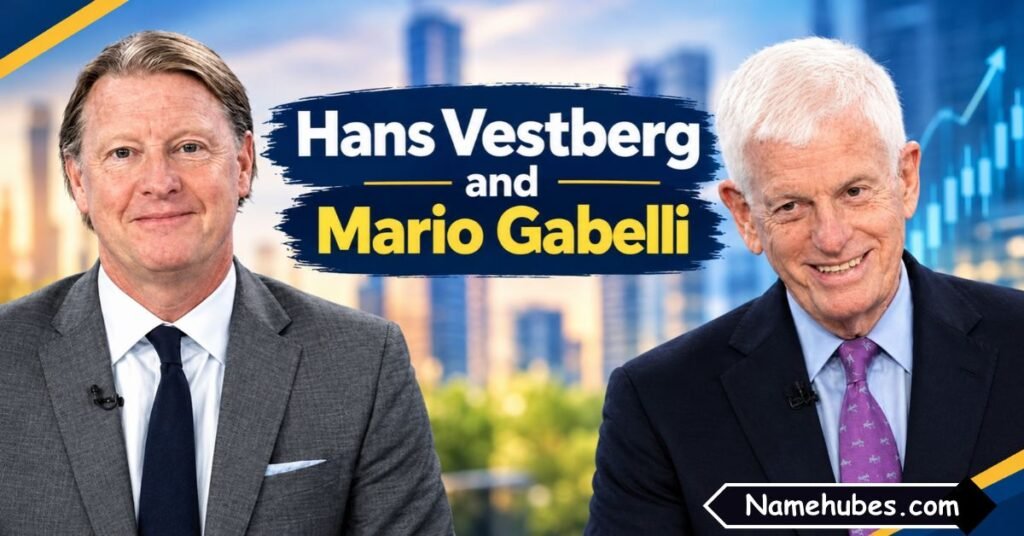
Are Hans Vestberg and Mario Gabelli business partners or just two names that keep landing in the same search results?
Just names.
No public record shows any shared company, board seat, or joint project.
Vestberg, a Swedish executive, ran Ericsson and then Verizon, where he pushed 5G, spectrum buys, and fiber expansion.
Gabelli, an American investor, founded GAMCO Investors and built a value investing approach around research and corporate catalysts.
One built networks.
The other studies what businesses are worth.
Their careers sit in different worlds yet share patience, deep industry knowledge, and long-term thinking.
Here are the verified facts, side by side, plus the leadership lessons each career offers.
Fact Check: Are Hans Vestberg and Mario Gabelli Connected?
Short answer: no.
No public record shows a personal or business partnership between Hans Vestberg and Mario Gabelli.
Neither man has described the other as a partner, mentor, or colleague.
There is no joint company, no shared board seat, and no common project in publicly available sources.
So why do people pair them up?
Search behavior explains most of it.
Vestberg led a telecom company whose shares trade on the stock market.
Gabelli runs a firm that studies and buys shares of public companies.
Investors watch the people who run the businesses they own and the people who size those businesses up.
That overlap puts two unrelated names into the same search results.
| Claim | Verdict | Why |
| They run a company together | Not supported | No joint company is on record |
| They share a board | Not supported | No shared board seat was found |
| They are family or close partners | Not supported | No public source says so |
| They are both well known in business | True | Each has a long, visible career |
| Their work touches the same markets | Loosely true | Telecom stocks attract value investors |
Who Is Hans Vestberg?

Hans Erik Vestberg is a Swedish business executive.
He is best known for two top jobs.
He served as CEO of Ericsson, the Swedish telecom equipment maker.
Later he served as CEO of Verizon Communications, one of the largest telecom companies in the United States.
Hans Vestberg’s Early Life and Education
Vestberg was born in 1965 in Hudiksvall, Sweden.
He earned a Bachelor of Business Administration degree from Uppsala University.
Sports shaped his early years too.
He played semi-professional team handball in Sweden.
His father, Jan Vestberg, coached him for much of that sports career.
Vestberg later founded the Jan Vestberg Handball Academy in his father’s name.
He is also a past chairman of the Swedish Olympic Committee and has served on the UN Foundation board.
| Detail | Information |
| Full name | Hans Erik Vestberg |
| Nationality | Swedish |
| Born | 1965, Hudiksvall, Sweden |
| Education | Bachelor of Business Administration, Uppsala University |
| Past CEO roles | Ericsson (2010 to 2016), Verizon (from 2018 until the handover to Dan Schulman) |
| Known for | Verizon’s 5G strategy |
| Sports link | Former semi-professional handball player |
His Career Before Verizon
Vestberg built his name at Ericsson long before Verizon called.
His early path ran through finance and regional leadership.
He served as chief financial officer, or CFO, of Ericsson Telecomunicações in Brazil.
He later led Ericsson Danmark as CEO.
From 2007 to 2009 he held the job of Ericsson Group CFO.
Those roles gave him a firm grip on both numbers and daily operations.
In 2010 he became President and CEO of Ericsson and held the post until 2016.
During those years Ericsson shifted from a hardware-focused maker toward software and services.
That shift is one reason Verizon later wanted him.
His career also covered several countries.
He worked in Brazil and Denmark and later led Ericsson’s global business from Sweden before moving to the United States for Verizon.
That path taught him to treat networks as global systems instead of local projects.
Hans Vestberg’s Leadership at Verizon
Verizon hired Vestberg in 2017.
He started as Chief Technology Officer and President of Global Networks.
That role gave him time to learn the company before he took the top seat.
In August 2018 he became CEO.
He added the chairman title in 2019.
Verizon announced a CEO change in October of last year.
Dan Schulman then replaced Vestberg as chief executive.
Verizon’s 5G Network and Digital Transformation
Vestberg is widely described as the architect of Verizon’s 5G strategy.
5G is the fifth generation of mobile network technology.
Verizon says it was first in the world to launch 5G and 5G Mobile Edge Compute under his leadership.
Mobile Edge Compute moves computing power closer to the user, which cuts delays.
The company then spread 5G across the United States for phones, home internet, and business services.
It also pushed 5G into private networks for factories, ports, and campuses.
Those networks show that 5G can do more than speed up a phone.
The biggest single bet came in 2021.
Verizon spent more than $45 billion in the FCC’s C-band spectrum auction.
The FCC, or Federal Communications Commission, regulates US airwaves.
Spectrum is the slice of airwaves a carrier needs to send signals.
That spending beat what T-Mobile and AT&T spent together.
Digital transformation leadership shaped the rest of the plan.
At Ericsson he had already helped move a hardware company toward software and services.
At Verizon the same mindset meant three things:
- Building faster and smarter networks
- Offering cloud and edge computing to business customers
- Preparing the company for artificial intelligence services
Hans Vestberg’s Leadership Strategy and Priorities
Vestberg’s stated aim was to build the connections that matter most to customers.
That covered mobility, cloud services, and newer AI applications.
His public record points to a clear order of priorities.
The list below shows how they stack up in his biggest decisions.
- Spend heavily on the network first.
- Buy the spectrum needed for a strong national 5G network.
- Extend fiber reach, including the $20 billion Frontier Communications deal announced during the handover period.
- Sell cloud and edge computing to business customers.
- Get the company ready for AI services.
His style fits those priorities.
He worked in engineering and finance roles before he became a CEO.
That mix let him judge a new technology and its price tag at the same time.
Telecom is slow and expensive.
Networks take years to build and spectrum costs billions.
A leader in that field has to plan far ahead, and his big bets show that habit.
Was Hans Vestberg a Good CEO?
The honest answer depends on the yardstick.
Judged by network investment, the record looks strong.
Verizon led the world in launching 5G.
It won major C-band spectrum.
It added fiber reach through the Frontier deal.
Verizon’s board chair said Vestberg led a new era of network investment and built a culture open to new ideas.
That praise carries weight because it comes from the people who oversaw his work.
Judged by customer numbers and share price, the picture is mixed.
Verizon lost postpaid phone lines early last year.
Postpaid customers pay a monthly bill after using the service, and they matter because they bring steady revenue.
The stock also dropped after the leadership announcement.
The end of his term was not smooth by every measure.
A fair verdict is that he was a strong network builder with a mixed scorecard on customer growth.
Is Verizon Still the Best Network?
Readers ask this because Vestberg spent his tenure focused on network quality.
Public facts about Verizon’s strategy do not settle a ranking, so a flat yes or no would be a guess.
Rankings change with who runs the test, what they measure, and where they measure it.
Speed, coverage, and reliability can each crown a different winner.
What the record does show is where Verizon placed its bets.
Those bets were early 5G, big spectrum purchases, and fiber expansion.
All three aim at long-term network strength.
Dan Schulman now leads the company, so results from here rest with him.
For a practical answer, check the newest independent tests and the coverage map for your own street.
A carrier that wins nationally can still lag in your neighborhood.
Who Is Mario Gabelli?
Mario J. Gabelli is an American investor, philanthropist, and business leader.
He was born in 1942 and is the founder, chairman, and CEO of GAMCO Investors.
He grew up in the Bronx, New York.
His career rests on one idea: buy good businesses for less than they are truly worth.
Mario Gabelli’s Background and Education
Gabelli grew up in a working family in the Bronx.
His mother was born in Italy.
His father’s family also had Italian roots.
He built his career through study and hard work.
His line about working from five to nine instead of nine to five became well known.
He studied at Fordham University and graduated summa cum laude, the highest tier of academic honors.
He then earned an MBA from Columbia Business School in 1967.
Columbia is closely tied to value investing.
It shaped many investors who followed that approach.
Education shaped his giving as well.
He serves on the Columbia Business School board of overseers.
He also supports Boston College and Roger Williams University.
In 2010 he and his wife made the largest gift in Fordham University’s history.
Fordham named a business center after him.
His Early Career in Investment Management
Gabelli began as a securities analyst at Loeb, Rhoades and Co.
A securities analyst studies companies and their stocks to judge what they are worth.
That job taught him to dig into company details.
Over time he built a method to estimate what a whole business would fetch from a private buyer.
That method became his signature idea.
He sees himself as an analyst first.
He studies companies, talks to managers, and looks for hidden value.
Later he became a media voice.
He appears on business television and has written for investment publications.
GAMCO Investors and Mario Gabelli’s Investment Career
GAMCO Investors is the firm at the center of Gabelli’s career.
It trades on the New York Stock Exchange under the symbol GBL.
It manages money in mutual funds, institutional accounts, and private accounts.
The Growth and Development of GAMCO Investors
Gabelli founded the firm in 1977.
It began as an institutional broker-dealer, a company that buys and sells securities for large clients.
Over time it grew into an asset manager and later became GAMCO Investors.
Gabelli remains its public face.
His circle of businesses reaches beyond GAMCO.
He is Executive Chairman of Associated Capital Group and Chairman of LICT Corporation.
The Gabelli name also appears on Gabelli Funds.
Industry honors followed over the years.
Morningstar named him Portfolio Manager of the Year.
Barron’s placed him on its All Star Century Team.
These milestones mark the main steps in his story:
- 1967: Earns his Columbia MBA
- 1977: Founds the firm that became GAMCO
- 1996: Receives the Ellis Island Medal of Honor for business leaders
- 2010: Makes a record gift to Fordham University
- 2022: Is inducted into the Horatio Alger Association
Gabelli’s Value-Investing Philosophy
Value investing means buying a stock for less than the business is worth and then waiting for the market to catch up.
Gabelli follows that idea and adds a twist he calls a catalyst.
A catalyst is an event that can unlock value.
It might be a sale, a merger, a spin-off, or a change in management.
A spin-off is a company splitting a unit off as its own separate business.
Without a catalyst a cheap stock can stay cheap for years.
With one the gap may close faster.
His approach is known as Private Market Value with a Catalyst.
It asks two questions.
What would a smart private buyer pay for this whole business?
And what could make the market notice?
Fundamental Analysis and Long-Term Value Creation
Fundamental analysis means studying a company’s real numbers.
Analysts look at sales, profit, debt, cash flow, and assets.
They also judge management quality and competition.
Gabelli’s team uses this work to estimate business value.
The goal is not to guess where a stock moves next week.
The goal is to know what the business is worth.
Long-term value creation adds patience to the mix.
Markets can be slow.
A good stock may stay cheap for a while.
Gabelli stresses solid businesses with durable products, steady cash, and honest managers.
Over the years such firms can build value even when the market ignores them.
Corporate events and market research complete the method.
His team follows mergers and acquisitions, buyouts, spin-offs, and corporate restructuring.
Analysts visit companies, speak with executives, and study industries.
Gabelli built a large research culture around that habit.
The team’s watch list looks like this:
- Takeover interest
- Asset sales and spin-offs
- Management changes
- The gap between market price and private buyer value
Hans Vestberg and Mario Gabelli: Comparing Their Careers
The two careers differ in kind but share a few traits.
Vestberg ran a giant operating company.
Gabelli runs an investment firm.
One builds networks and the other studies what businesses are worth.
Telecommunications Leadership vs. Investment Management
This table sets the main facts side by side.
| Area | Hans Vestberg | Mario Gabelli |
| Main field | Telecommunications | Investment management |
| Home country | Sweden | United States |
| Education | Uppsala University | Fordham University, Columbia MBA |
| Signature companies | Ericsson and Verizon | GAMCO Investors |
| Signature idea | 5G leadership | Private Market Value with a Catalyst |
| Style | Operator and builder | Analyst and allocator |
| Giving and service | UN Foundation, sports | Education, culture, health causes |
Different Approaches to Strategy, Innovation, and Value
Vestberg’s path is the operator’s path.
He rose through finance and country leadership roles and then ran two global telecom giants.
His success depended on managing large teams and huge capital projects.
Gabelli’s path is the investor’s and founder’s path.
He started with research and then built his own firm over decades.
His success depended on judgment, patience, and a strong brand.
Their strategies reflect those roots.
Vestberg planned in years and billions of dollars through spectrum, fiber, and 5G.
Gabelli planned events such as a sale, a merger, or a spin-off.
Their innovation differs too.
Vestberg’s came from technology like private 5G networks and edge computing.
Gabelli’s came from a method for estimating private buyer value.
Value means something different to each man.
Vestberg spoke about serving customers, shareholders, employees, and society, a mix often called stakeholder value.
Gabelli aims to grow client wealth while backing education and culture.
Both paths carry risk.
Operators face huge spending and fast technology change.
Investors face market swings and the chance of being wrong.
There is no single road to business success.
Their Professional Influence and Industry Contributions
Each man shaped his industry in a clear way.
Vestberg influenced how a major carrier built next-generation networks.
Gabelli influenced how many investors think about business value and catalysts.
The two fields also depend on each other.
Telecom firms need capital and investors need good companies.
A strong network business can become a steady investment.
A sharp investor can push a company toward better decisions.
Hans Vestberg’s Impact on Connectivity
Connectivity is now basic infrastructure.
Phones, cars, hospitals, and factories depend on it.
Vestberg’s work helped push 5G from a promise into a product.
Private networks gave factories, ports, and campuses a new tool.
He also showed how a telecom leader can speak to the public.
He talked about technology, climate, and inclusion at global forums and technology events.
That helped Verizon present itself as more than a phone company.
Mario Gabelli’s Influence on Value Investing
Gabelli’s work centers on one skill: seeing what a business is really worth.
That sounds simple but proves hard in practice.
His approach influenced many analysts.
It reminds investors that a stock is a piece of a real company.
Price is not the same as value.
His catalyst idea added a practical twist.
A cheap stock needs a reason for the market to notice it.
Business television and investor conferences made him a public face for the method.
His investment research culture still marks how many firms study companies today.
Frequently Asked Questions About Hans Vestberg and Mario Gabelli
These quick answers cover the questions readers ask most.
Are Hans Vestberg and Mario Gabelli Professionally Connected?
No.
No public source shows a personal or business link between them.
They have no joint company, no shared board seat, and no common project.
They are separate leaders in different industries.
Is Hans Vestberg Still the CEO of Verizon?
No.
Vestberg was Verizon CEO from 2018 until Dan Schulman replaced him after the October announcement last year.
Vestberg served as a special advisor through October 4, 2026.
He also remained on the board until the 2026 annual meeting.
What Is Mario Gabelli Best Known For?
Gabelli is best known for value investing and his Private Market Value with a Catalyst method.
He founded GAMCO Investors and serves as its chairman and CEO.
He is also a major donor to education.
Where Did Hans Vestberg and Mario Gabelli Study?
Vestberg earned a business degree at Uppsala University in Sweden.
Gabelli studied at Fordham University and earned an MBA from Columbia Business School in 1967.
Final Thoughts on Hans Vestberg and Mario Gabelli
Hans Vestberg and Mario Gabelli share no documented link.
Public records show no joint company, shared board seat, or common project.
Vestberg, a Swedish executive, led Ericsson and then Verizon, where he drove the 5G strategy, the C-band spectrum purchase, and fiber expansion.
Dan Schulman later replaced him as CEO.
Gabelli, an American investor, founded GAMCO Investors and built the Private Market Value with a Catalyst method on research and patience.
Their careers differ in field but share long-term thinking, deep industry knowledge, and a strong professional reputation.
Those habits offer useful lessons for any leader or investor to follow.
Related Posts:
- Travis Kalanick and Helen Mirren: Their Stories Explained
- Francie Frane Age, Husband, Kids, Net Worth & Personal Life
- Brianna Lyman: Age, Husband, Career, Height & Net Worth
- Jessica Chastain and Mike Krieger: Their Connection Explained
- Safra Catz and Diane von Furstenberg: What Connects Them?
- Johann Rupert and Javier Bardem: Exploring Their Connection
- Leonardo DiCaprio and Emma Walmsley: Two Different Paths
