

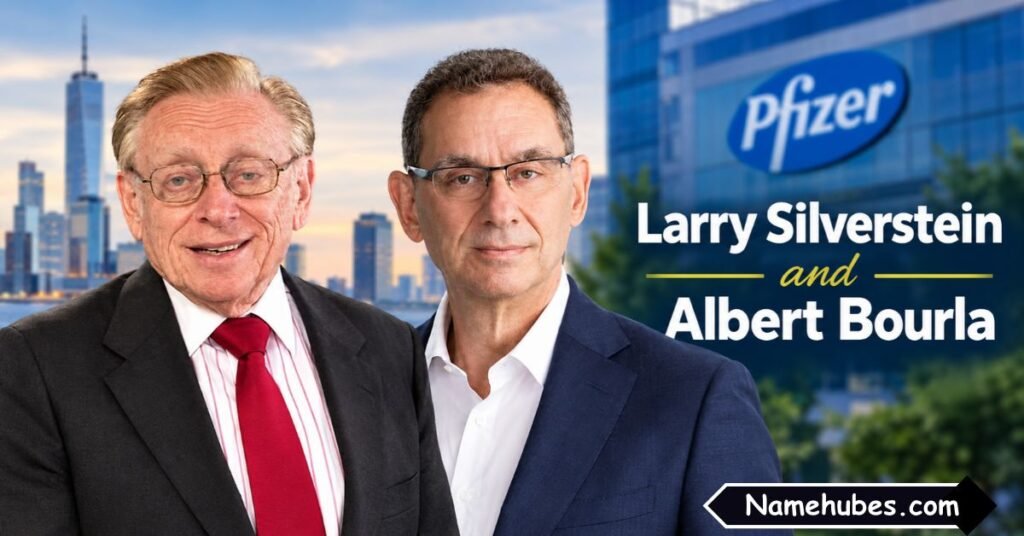
You’ve probably seen Larry Silverstein and Albert Bourla named together online and wondered why. Silverstein is a New York real estate developer who helped rebuild the commercial towers at the World Trade Center site. Bourla is the Greek-American chairman and CEO of Pfizer, the drugmaker behind a widely used COVID-19 vaccine. Their industries barely overlap in daily operations.
Their names do cross paths through a 2022 awards announcement that honored Pfizer and executives from Silverstein Properties. That overlap is real but limited in scope. Below, you’ll find both biographies, their major projects, the documented link between them, and clear answers to the questions people ask most about these two leaders.
Larry Silverstein and Albert Bourla: Quick Biography
| Detail | Larry Silverstein | Albert Bourla |
| Full name | Larry A. Silverstein | Albert A. Bourla |
| Nationality | American | Greek-American |
| Main industry | Real estate development | Pharmaceuticals and biotechnology |
| Associated organization | Silverstein Properties | Pfizer |
| Leadership position | Founder and chairman | Chairman and CEO |
| Education | New York University and Brooklyn Law School | Aristotle University of Thessaloniki |
| Best known for | World Trade Center redevelopment | Leading Pfizer through the COVID-19 pandemic |
| Main professional focus | Property investment, development, and management | Pharmaceutical research, development, and commercialization |
Who Is Larry Silverstein?
Larry A. Silverstein is an American real estate developer. He founded Silverstein Properties, a privately held development, investment, and management firm established in 1957. He still serves as its chairman.
Most people know him through the World Trade Center. He held the lease on the complex when terrorists attacked it on September 11, 2001. He then became a central private-sector figure in rebuilding Lower Manhattan.
His résumé goes well beyond that single site. Silverstein Properties has developed and managed commercial buildings, residential towers, hotels, and retail space across New York and other markets.
Think of a developer as a general contractor for an entire city block. Silverstein has to line up money, designs, permits, builders, and tenants. Then he has to keep all of them moving in the same direction for years.
Larry Silverstein’s Early Career and Rise in Real Estate
Silverstein started in real estate during the 1950s. He worked alongside his father and business partners. Together they bought properties and learned the commercial market from the ground up. The firm took formal shape in 1957 and grew with New York City’s changing economy.
He also trained as a lawyer. His education at New York University and Brooklyn Law School gave him a useful edge. Real estate deals live and die on contracts, zoning rules, and financing terms.
Over the following decades, the company moved into larger office projects. Silverstein Properties developed the original 7 World Trade Center in the 1980s. That project tied the firm to the Trade Center neighborhood long before 2001.
Commercial real estate is a capital-hungry business. Developers often spend heavily before a single tenant pays rent. Returns then depend on interest rates, occupancy levels, and the broader economy. A developer who survives several market cycles usually has strong relationships with lenders and tenants.
That long runway explains why Silverstein could step into a deal as large as the World Trade Center lease. He had spent roughly four decades building credibility first.
Where Did Larry Silverstein Build His Wealth?
Silverstein built his wealth through real estate. He did not get there through a single windfall. Rental income from office towers, appreciation in property values, and development profits formed the core of his earnings over many decades.
The World Trade Center played a major role as well. After the attacks, insurance claims linked to the destroyed buildings became the subject of long legal fights. Those disputes ended in settlements reported at roughly $4.5 billion. That money went toward rebuilding. It was not a personal payday.
This point matters because the numbers get misread online. Insurance proceeds funded construction costs. They did not simply land in a private bank account.
Silverstein Properties also developed residential and hospitality projects. One example is the tower at 30 Park Place in Lower Manhattan, which combines a hotel with condominiums.
What about his net worth? Published estimates differ widely from one outlet to the next. The company is private and doesn’t release audited financials. Treat any single figure as an estimate rather than a confirmed number.
Larry Silverstein and the World Trade Center Lease
In 2001, Silverstein Properties and Westfield America signed a 99-year lease with the Port Authority of New York and New Jersey. The deal covered the World Trade Center complex, including the Twin Towers. It carried a value of about $3.2 billion.
The timing is what makes this lease so famous. The agreement closed only weeks before the September 11 terrorist attacks. The lease suddenly covered a site in ruins.
The attacks killed thousands of people. They also raised hard questions about insurance coverage, rebuilding duties, and who would pay for what. Courts and insurers spent years sorting through policy language.
Keep three things separate when you read about this period:
- The original lease transaction in 2001
- The insurance litigation that followed
- The construction of new buildings after the attacks
Each one involved different parties, different rules, and different decisions. Blending them together causes much of the confusion around Silverstein’s story.
Rebuilding the World Trade Center After 9/11
After the attacks, Silverstein committed to rebuilding the commercial towers. The work required teamwork among the Port Authority, architects, engineers, construction firms, lenders, and city officials. Every decision also carried emotional weight because the site honored the people who died there.
Silverstein Properties developed three of the new office buildings:
- 7 World Trade Center, which reopened in 2006
- 4 World Trade Center, which opened in 2013
- 3 World Trade Center, which opened in 2018
The Port Authority built One World Trade Center. Plans for 2 World Trade Center have moved much more slowly.
These projects did more than add office space. They helped pull businesses back to Lower Manhattan. Tenants from finance, media, and technology eventually filled the new towers.
The rebuilding also showed how slow large urban projects can be. Safety standards changed. Financing shifted. Public expectations stayed high. Silverstein’s name became tied to all of it. For many readers, that history defines his public reputation.
Who Is Albert Bourla?
Albert A. Bourla is a Greek-American pharmaceutical executive. He serves as chairman and chief executive officer of Pfizer. Bourla was born in Thessaloniki, Greece. He studied veterinary medicine at Aristotle University of Thessaloniki and later earned a doctorate in the biotechnology of reproduction.
His path looks nothing like Silverstein’s. He didn’t come up through real estate or law. He started as a scientist who understood animals and biology. He later learned the business side of medicine.
Pfizer is one of the world’s largest biopharmaceutical companies. It makes medicines and vaccines used across oncology, immunology, and infectious disease. Running it means coordinating researchers, doctors, regulators, manufacturers, and investors in dozens of countries.
Bourla became widely known during the COVID-19 pandemic. Yet his career at Pfizer stretches back to the early 1990s. The pandemic simply put him in front of a global audience.
Albert Bourla’s Career and Leadership at Pfizer
Bourla joined Pfizer in 1993 in the animal health division. Over the next two decades he took on larger roles. He managed operations in Europe, the Middle East, and Africa. He later led businesses covering vaccines, oncology, consumer health, and established medicines.
Those posts gave him exposure to every stage of the drug business. He saw product strategy, market access, manufacturing, and international operations up close. He then served as chief operating officer before taking the top job.
He became Pfizer CEO in January 2019. He later added the chairman title.
Under his leadership, Pfizer has leaned on scientific innovation and big strategic bets. The 2023 acquisition of Seagen is a good example. Seagen specializes in antibody-drug conjugates, a type of targeted cancer treatment. The deal strengthened Pfizer’s oncology lineup considerably.
The company has also pushed into obesity and metabolic disease. It has explored artificial intelligence in drug discovery too. These moves show how a modern pharmaceutical CEO has to think about science and strategy at the same time. A great molecule means little without manufacturing capacity and regulatory approval behind it.
Albert Bourla and the COVID-19 Vaccine Development
Pfizer partnered with the German biotechnology company BioNTech in early 2020. Their goal was an mRNA vaccine against COVID-19. BioNTech brought deep expertise in messenger RNA technology. Pfizer brought clinical development muscle, manufacturing scale, and global distribution experience.
The timeline moved quickly. In November 2020, the companies announced positive early results from their Phase 3 clinical trial. In December 2020, the U.S. Food and Drug Administration granted emergency use authorization. Other regulators then reviewed the vaccine under their own rules.
Bourla’s role centered on executive leadership. He guided decisions, spoke with governments and investors, and pushed the company to scale up production. Pfizer had to build supply chains almost overnight.
Still, you shouldn’t credit one person with the science. Researchers at both companies, trial volunteers, clinical investigators, factory workers, and regulatory staff all shaped the outcome. The vaccine was a team effort.
The program also drew scrutiny. People debated pricing, procurement contracts, safety monitoring, and pharmaceutical profits. Those debates deserve evidence from clinical data and contracts rather than assumptions about any single executive.
Bourla later published Moonshot: Inside Pfizer’s Nine-Month Race to Make the Impossible Possible. The book gives his own account of the urgency and the internal choices.
| Also Read This Celebs |
| Peter Orszag’s Hair: Exploring the Wig and Toupee Rumors |
| Coco Vandi: Age, Biography, Career and Net Worth Explained |
| John Paulson and Bob Chapek: Wealth, Careers and Success |
Pfizer’s Global Business Strategy and Pharmaceutical Influence
Pfizer does far more than vaccines. Its portfolio covers oncology, internal medicine, inflammation and immunology, and infectious diseases. The company sells products in most regions of the world.
Pharmaceutical research is a long game. A drug candidate can spend a decade or more in testing before approval. Most candidates never make it. Companies therefore need deep pockets and patience.
Acquisitions can speed things up. Buying Seagen gave Pfizer new technology and a ready pipeline of cancer medicines. That kind of move can shorten the road to market.
The industry also faces steady pressure. Patent expirations open the door to cheaper generics. Clinical trials sometimes fail. Regulations change. Governments and patients argue loudly about drug prices.
Bourla’s job requires balancing all of that. He has to protect scientific ambition and financial health at once. He also has to keep patients at the center of the conversation. That balancing act shapes Pfizer’s corporate strategy and its influence in international healthcare.
Larry Silverstein and Albert Bourla: Is There a Connection?
The short answer is yes, but only a narrow one. No evidence reviewed for this article shows a direct business partnership between the two men.
The documented link comes from the America-Israel Friendship League. On November 2, 2022, the organization announced that Pfizer and its CEO would receive the Kenneth J. Bialkin Leadership Award. The same announcement named Lisa Silverstein and Tal Kerret, executives at Silverstein Properties, as recipients of the Partners for Democracy Award.
So the connection exists at the organizational level. Executives from both companies were honored through the same awards program.
Here’s what that announcement does not show:
- It doesn’t name Larry Silverstein as an award recipient.
- It doesn’t describe a joint company or shared investment.
- It doesn’t point to a personal friendship.
Being honored by the same group doesn’t create a business relationship. Plenty of unrelated leaders attend the same galas. Stronger proof would need a joint press release, a regulatory filing, a signed agreement, or credible reporting based on records.
For that reason, the most accurate description is a documented organizational overlap. It is not a personal or financial partnership.
Comparing Larry Silverstein and Albert Bourla’s Careers and Industries
At first glance, a developer and a drug executive have little in common. Yet their leadership roles share a few traits. Both manage huge sums of money. Both depend on long timelines. Both make choices that ripple far beyond their own companies.
A skyscraper can take years to plan and finance before the first tenant arrives. A new medicine can take just as long to move from lab bench to pharmacy shelf.
The risks look very different, though. Silverstein deals with property cycles, construction costs, interest rates, insurance, and tenant demand. Bourla deals with trial results, safety data, manufacturing quality, patent timing, and regulatory approval.
Their decisions touch different groups too. Real estate affects tenants, construction crews, neighbors, and the shape of a city. Pharmaceutical choices affect patients, doctors, researchers, and public health systems.
A comparison like this helps explain why both men draw attention. It does not prove that they worked together. You can compare two executives without implying a hidden relationship.
Why Are Larry Silverstein and Albert Bourla Searched Together?
Combined-name searches usually start with a shared mention somewhere. Someone reads an awards list. Someone else sees both names in a roundup of powerful business figures. A curious reader then types both names into a search bar.
In this case, the 2022 America-Israel Friendship League announcement is the clearest trigger. It placed Pfizer’s leadership and Silverstein Properties executives in the same coverage.
Search engines also reward pages that mention two names together. That can make a thin connection look bigger than it is.
You can protect yourself with a simple habit. Check the original context before you accept a claim. Ask whether a source shows an agreement, a filing, or an on-the-record statement. If it doesn’t, treat the claim as speculation.
Good research separates documented facts from online chatter. That approach serves you better than any viral theory.
Frequently Asked Questions
Are Larry Silverstein and Albert Bourla Business Partners?
No evidence reviewed for this article shows that they are. Silverstein founded a real estate firm. Bourla leads a pharmaceutical company. A 2022 awards announcement linked Pfizer and Silverstein Properties executives through the same program. It didn’t describe a joint venture between the two men.
Is Albert Bourla Israeli?
No. Bourla was born in Thessaloniki, Greece. He is a Greek-American executive. Public profiles describe him as having Jewish heritage. Nothing in public records presents him as an Israeli citizen. His name sometimes appears alongside Israel-related organizations because Pfizer has worked with governments around the world.
Is Albert Bourla Married?
Yes. Public profiles identify his wife as Myriam. He keeps his family life largely private. Beyond that, you won’t find many verified personal details in reliable reporting.
Where Did Larry Silverstein Get His Money?
Silverstein built his wealth through real estate. Rental income, property appreciation, and development profits drove his earnings across several decades. His work at the World Trade Center added a major chapter. Insurance settlements tied to the site mostly funded reconstruction. Estimates of his net worth vary widely because his firm is private.
Are Larry Silverstein and Donald Trump Friends?
The public record shows they are longtime peers in New York real estate. Some business reporting has described Silverstein Properties’ owner as an associate of Trump. Silverstein supported Hillary Clinton in 2016. He also said he hoped Trump would govern from the center. No reliable source documents a close personal friendship, so the word “friends” goes further than the evidence.
What Companies Are Associated With Larry Silverstein and Albert Bourla?
Silverstein is associated with Silverstein Properties, a real estate development and investment firm. Bourla leads Pfizer, a multinational biopharmaceutical company. Pfizer also partnered with BioNTech on its COVID-19 vaccine, and it acquired Seagen in 2023.
Do Larry Silverstein and Albert Bourla Work in the Same Industry?
No. Silverstein works in real estate development and property management. Bourla works in pharmaceuticals and biotechnology. You can compare their leadership styles and corporate responsibilities. Their day-to-day work has almost nothing in common.
Conclusion
Larry Silverstein and Albert Bourla built successful careers in very different industries. Silverstein made his mark in real estate through Silverstein Properties and the World Trade Center redevelopment after 9/11. Bourla became widely recognized as Pfizer’s CEO, particularly for leading the company during the COVID-19 vaccine development with BioNTech. Both have influenced major organizations and industries through their leadership.
Their documented connection comes from a November 2022 America-Israel Friendship League awards announcement involving Pfizer and Silverstein Properties executives. However, there is no confirmed evidence of a direct business partnership, shared investment, or personal friendship between them.
