

If you’ve been digging through old family records or just love the sound of a name with real history behind it, Victorian names from the 1800s are worth a look. These names come from parish registers, census returns, and family Bibles from Queen Victoria’s reign, and many of them still sound fresh today.
This guide walks you through the most popular Victorian names, along with classic, royal, floral, biblical, and rare picks for both boys and girls. You’ll also find a section on surnames and a list of old names that have quietly made their way back into modern nurseries.
What Are Victorian Era Names?
Victorian names come from Britain and America between 1837 and 1901, the years Queen Victoria sat on the throne. Parents during this time leaned on a handful of naming traditions at once. Biblical names stayed strong in Anglican, Methodist, Baptist, and Catholic households. Royal events, like a new princess or a royal wedding, sent names like Adelaide and Beatrice climbing.
Literary revivals brought back medieval and Anglo-Saxon names, and a growing love of nature gave rise to botanical names like Violet and Ivy. Class mattered too. Upper-class and educated families often chose elaborate or literary names, while working-class families in industrial cities tended to stick with shorter, familiar biblical or classic names.
Most Popular Victorian Names in the 1800s for Boys and Girls
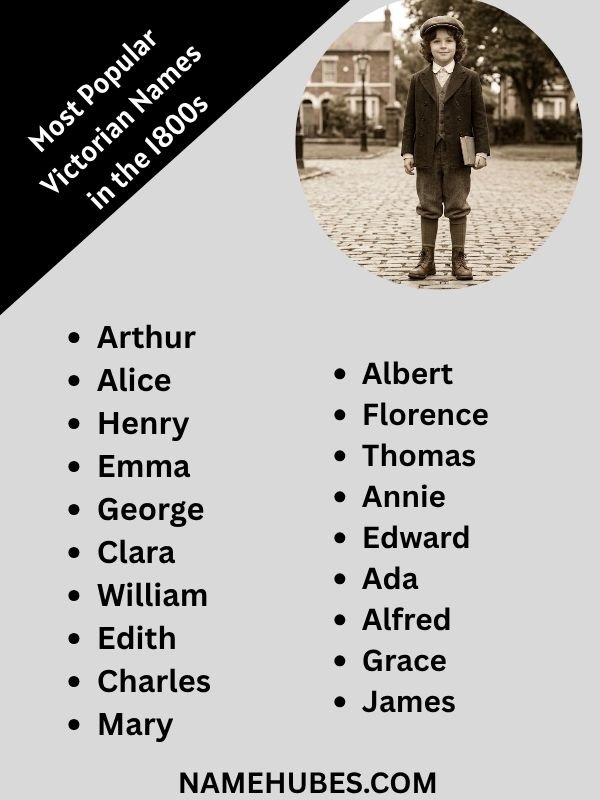
Parish baptism records and British civil registration data from the 1841 and 1860s censuses show a small group of names dominating birth registers on both sides of the Atlantic. These were the safe, expected choices most families reached for.
- Mary — the single most common Victorian female name
- Elizabeth — a royal and biblical staple
- Anna — simple and widely used across classes
- Emma — popular among middle-class English families
- Margaret — common in both Britain and America
- Sarah — a steady biblical favorite
- Jane — plain, practical, and everywhere in parish records
- Catherine — favored by aristocratic and middle-class families alike
- Eleanor — a medieval revival name that never fully faded
- Alice — boosted by Lewis Carroll’s famous book
- William — the top Victorian boy’s name by a wide margin
- John — the most common name in British civil registration
- James — steady across every social class
- Charles — royal ties kept it fashionable
- George — linked to earlier Hanoverian kings, still popular
- Henry — a name with centuries of royal history
- Thomas — common in both rural counties and industrial cities
- Edward — royal and reliable
- Joseph — a biblical name used across all denominations
- Arthur — tied to medieval revival and the Duke of Wellington era
Also Read : 240+ Funny R6 Names: Cool, Sweaty & Unique Ideas
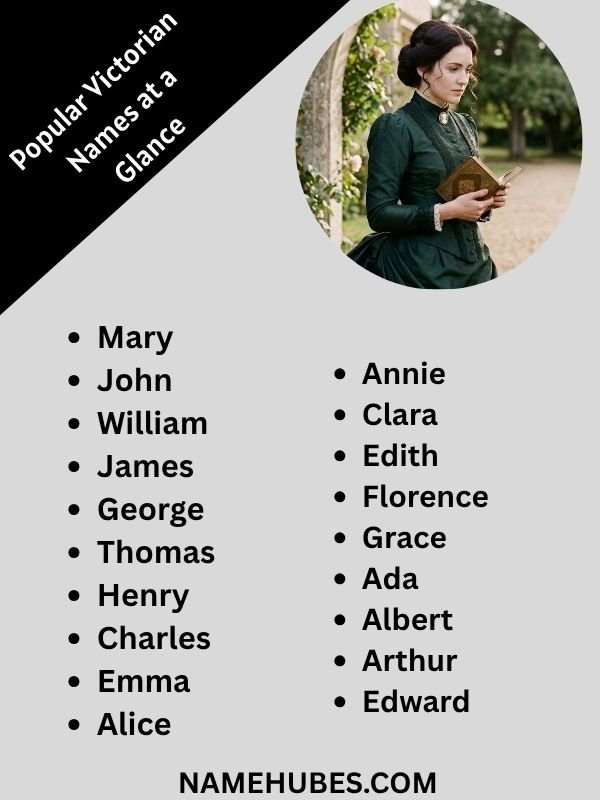
Popular Victorian Names at a Glance
| Name | Gender | Why It Was Popular |
| Mary | Girl | Biblical and royal roots |
| William | Boy | Most common Victorian boy’s name |
| Elizabeth | Girl | Royal and biblical staple |
| John | Boy | Dominated civil registration records |
| Emma | Girl | Middle-class English favorite |
| Charles | Boy | Royal association |
| Sarah | Girl | Common biblical choice |
| George | Boy | Hanoverian royal influence |
| Alice | Girl | Popularized by literature |
| Henry | Boy | Long royal history |
Victorian Girl Names from the 1800s
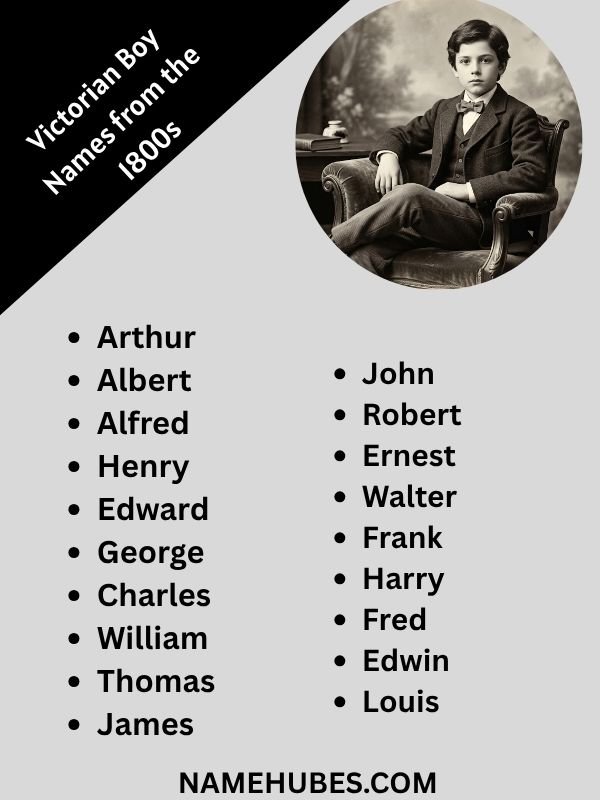
Girl names from this era range from plain and practical to elaborate and romantic. You’ll find biblical names sitting right next to names inspired by Shakespeare, Queen Victoria’s own children, and the flowers growing in Victorian gardens.
Victorian Girl Names at a Glance
| Category | Example Names |
| Classic | Frances, Harriet, Martha |
| Royal | Adelaide, Beatrice, Victoria |
| Floral | Violet, Rose, Ivy |
| Short | Ada, Mae, Nell |
Classic Victorian Girl Names
- Frances — a formal, gender-neutral favorite of the era
- Susannah — common in Nonconformist communities
- Harriet — familiar and warm-sounding
- Louisa — a graceful alternative to Louise
- Julia — used across both upper and middle-class homes
- Charlotte — steady from the Georgian era into Victorian times
- Amelia — soft and formal at once
- Caroline — a name with a long royal pedigree
- Dorothy — meaning “gift of God”
- Martha — a biblical name found in every parish register
- Grace — simple, virtue-based, and widely used
- Esther — a biblical name with quiet strength
- Rebecca — common in Nonconformist and Baptist families
- Hannah — plain, biblical, and popular in every region
- Ruth — short, biblical, and easy to pronounce
- Ellen — a softer form of Helen
- Laura — used across Britain and America alike
- Marion — a name that quietly bridged classes
- Kate — often a formal name in its own right, not just a nickname
- Priscilla — favored in devout Nonconformist households
Also Read : 450+ Best Sweaty Fortnite Names for Tryhards & Pros 2026
Royal Victorian Girl Names
- Adelaide — after Queen Adelaide, William IV’s wife
- Beatrice — Queen Victoria’s youngest daughter, Princess Beatrice
- Victoria — the queen’s own name, used sparingly out of respect
- Alexandra — after the future Queen Alexandra, Edward VII’s wife
- Augusta — a name tied to earlier royal generations
- Isabella — a name with deep European royal roots
- Theodora — rare, but favored in aristocratic circles
- Matilda — an old royal name revived by Victorian romanticism
- Georgiana — a feminine form honoring King George
- Henrietta — a feminine form of Henry with royal ties
- Wilhelmina — a formal, German-influenced royal choice
- Cordelia — pulled from Shakespeare’s King Lear
- Arabella — an aristocratic favorite with a musical sound
- Constance — a virtue name common among titled families
- Millicent — old English, favored by upper-class households
- Gwendolyn — a Celtic revival name gaining royal-adjacent appeal
- Winifred — Welsh in origin, popular in genteel families
- Ophelia — another Shakespearean pick tied to the literary revival
- Genevieve — French-influenced and aristocratic
- Evangeline — inspired by Longfellow’s popular poem
Floral Victorian Girl Names
- Violet — one of the most enduring floral Victorian names
- Rose — timeless and still common today
- Olive — tied to the olive branch and quiet strength
- Lavender — rare, fragrant, and distinctly Victorian
- Ivy — climbing, resilient, and increasingly fashionable in the era
- Hazel — named for the tree and its warm brown color
- Iris — after the flower and the Greek goddess of the rainbow
- Flora — meaning “flower” outright
- Jessamine — an old-fashioned spelling of jasmine
- Daisy — cheerful and simple
- Myrtle — an evergreen shrub name with old-world charm
- Poppy — bold and increasingly popular by the century’s end
- Marigold — bright and golden, a less common pick
- Camellia — elegant and rare
- Magnolia — used more in the American South
- Fern — quiet, green, and understated
- Heather — Scottish botanical roots
- Laurel — tied to victory and honor
- Primrose — delicate and springlike
- Blossom — soft and rarely used, making it stand out
Short Victorian Girl Names
| Name | Description | Name | Description |
| Ada | Short, sharp, and stylish even now | Mae | A soft, one-syllable classic |
| Ida | Plain and easy to say | Etta | Often short for Henrietta |
| Elsie | A pet form that became its own name | Nell | Short for Eleanor or Ellen |
| Bess | A warm short form of Elizabeth | Effie | Short for Euphemia |
| Nan | A friendly short form of Anne | Tilly | A playful short form of Matilda |
| Cissy | Short for Cecilia | Fannie | A common short form of Frances |
| Kit | Brisk and unusual for a girl’s name today | Liz | A shortened Elizabeth used on its own |
| Bea | Short for Beatrice, sweet and simple | Cora | Short, classic, and standalone |
| Mabs | A rare short form of Mabel | Dot | Short for Dorothy |
| Lil | Short for Lillian | Peg | A lively short form of Margaret |
Victorian Boy Names from the 1800s
Boy names in this era leaned heavily on tradition. Biblical names, royal names, and strong Anglo-Saxon names all had their place, and many of them are having a real comeback right now.
Victorian Boy Names at a Glance
| Category | Example Names |
| Classic | Alfred, Walter, Ernest |
| Strong | Albert, Isaac, Robert |
| Biblical | Jacob, Elijah, Ezra |
| Rare | Sebastian, Leopold, Cyrus |
Classic Victorian Boy Names
- Alfred — meaning “wise counsel,” a steady English classic
- Frederick — royal and German-influenced
- Leonard — meaning “brave lion”
- Louis — common among both French and British families
- Martin — plain and dependable
- Philip — a name with ancient Greek roots
- Sidney — used as both a first and family name
- Walter — Germanic in origin, meaning “ruler of the army”
- Edmund — an old English royal name
- Ernest — later immortalized by Oscar Wilde’s famous play
- Harold — tied to England’s last Anglo-Saxon king
- Raymond — Germanic, meaning “wise protector”
- Reginald — formal and slightly aristocratic
- Victor — meaning “conqueror,” fittingly regal-sounding
- Vincent — Latin in origin, meaning “to conquer”
- Wilfred — Old English, meaning “desiring peace”
- Benjamin — a steady biblical classic
- Samuel — biblical and widely used across classes
- Richard — a name with centuries of English royal history
- Stephen — biblical, meaning “crown”
Strong Victorian Male Names
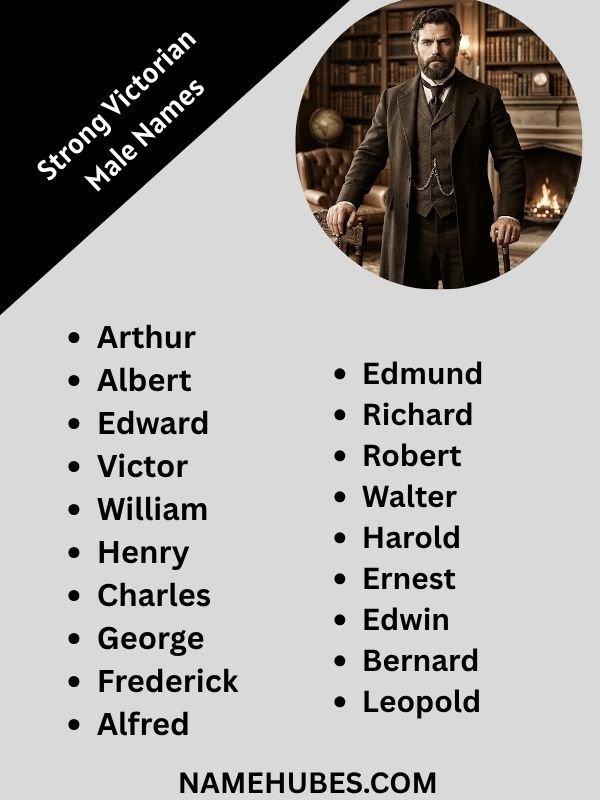
- Albert — after Prince Albert, Queen Victoria’s beloved husband
- Isaac — biblical, meaning “he will laugh”
- Nathaniel — biblical, meaning “gift of God”
- Theodore — Greek, meaning “gift of God”
- Wesley — after John Wesley, founder of Methodism
- Cedric — a literary name with a medieval feel
- Frank — short, direct, and increasingly used as a standalone name
- Hugh — Germanic, meaning “mind” or “spirit”
- Oscar — Irish in origin, popularized by literary and royal ties
- Percival — a name pulled from Arthurian legend
- Rupert — German royal roots
- Herbert — Germanic, meaning “bright army”
- Horace — Latin, tied to classical education
- Lawrence — Latin in origin, meaning “from Laurentum”
- Matthew — biblical, meaning “gift of God”
- Nathan — biblical and short
- Owen — Welsh, meaning “young warrior”
- Peter — biblical, meaning “rock”
- Robert — Germanic, meaning “bright fame”
- Simon — biblical, meaning “he has heard”
Biblical Victorian Boy Names
| Name | Meaning / Description | Name | Meaning / Description |
| Jacob | Meaning “supplanter” | Aaron | Brother of Moses in the Old Testament |
| Abraham | Meaning “father of many” | Amos | A minor prophet’s name |
| Caleb | Meaning “faithful” or “whole-hearted” | Daniel | Meaning “God is my judge” |
| Elias | A variant of Elijah | Elijah | Meaning “the Lord is my God” |
| Enoch | Meaning “dedicated” | Ezra | Meaning “help” |
| Hiram | A biblical king’s name | Jeremiah | Meaning “the Lord will exalt” |
| Job | A name tied to patience and endurance | Joel | Meaning “the Lord is God” |
| Jonah | Famous for the story of the whale | Josiah | A biblical king’s name |
| Levi | One of the twelve tribes of Israel | Malachi | The last prophet in the Old Testament |
| Micah | Meaning “who is like God” | Moses | One of the most significant names in the Bible |
Rare Victorian Boy Names
- Sebastian — Latin in origin, meaning “venerable”
- Maximilian — formal and rarely used outside noble families
- Benedict — meaning “blessed”
- Ambrose — Greek, meaning “immortal”
- Algernon — a genuinely rare English name of Norman French origin
- Barnaby — an English form of Barnabas
- Cuthbert — an Old English saint’s name
- Ezekiel — a major Old Testament prophet
- Leopold — after Queen Victoria’s own son, Prince Leopold
- Silas — biblical, meaning “man of the forest”
- Thaddeus — one of the twelve apostles
- Cyrus — a Persian royal name
- Orson — meaning “bear cub” in Old French
- Gideon — a biblical judge and warrior
- Otto — Germanic, meaning “wealth”
- Bennett — a Norman French surname turned first name
- Alaric — Germanic, meaning “ruler of all”
- Aldous — Old English, meaning “old” or “wise”
- Baldric — a rare Germanic name meaning “brave ruler”
- Cornelius — Latin, meaning “horn”
Common Victorian Names in the 1800s
These names appeared again and again in baptism entries across industrial cities and rural counties alike, cutting across denominations and class lines.
- Naomi — a biblical name meaning “pleasantness”
- Miriam — a biblical name and sister of Moses
- Letitia — Latin, meaning “joy” or “gladness”
- Kezia — a biblical name meaning “cassia,” a fragrant spice
- Georgina — a feminine form of George
- Felicity — Latin, meaning “happiness”
- Estelle — French in origin, meaning “star”
- Cassandra — a Greek mythological name
- Anastasia — Greek, meaning “resurrection”
- Persis — a biblical name meaning “Persian woman”
- Tobias — biblical, meaning “God is good”
- Edwin — Old English, meaning “wealthy friend”
- Horatio — Latin, popularized by Admiral Nelson
- Clement — Latin, meaning “merciful”
- Calvin — Latin, meaning “bald,” used in Nonconformist families
- Timothy — biblical, meaning “honoring God”
- Nigel — a medieval revival name
- Godfrey — Germanic, meaning “God’s peace”
- Ivor — Welsh and Scandinavian roots
- Quentin — Latin, meaning “fifth”
Elegant and Classic Victorian Names
- Delphine — French, meaning “from Delphi”
- Beulah — biblical, meaning “married”
- Ottilie — Germanic, meaning “prosperous in battle”
- Verity — a virtue name meaning “truth”
- Sibyl — Greek, referring to ancient prophetesses
- Tamsin — an English form of Thomasina
- Lettice — an old English form of Letitia
- Jemima — biblical, meaning “dove”
- Rhoda — Greek, meaning “rose”
- Keturah — a biblical name meaning “incense”
- Lysander — Greek, meaning “liberator”
- Peregrine — Latin, meaning “traveler” or “pilgrim”
- Sylvester — Latin, meaning “wooded” or “wild”
- Roderick — Germanic, meaning “famous ruler”
- Magnus — Latin, meaning “great”
- Fergus — Gaelic, meaning “man of vigor”
- Ignatius — Latin, meaning “fiery”
- Crispin — Latin, meaning “curly-haired”
- Merrick — Welsh, a form of Meurig
- Kenelm — Old English, meaning “bold helmet”
Rare and Unique Victorian Names
- Hepzibah — biblical, meaning “my delight is in her”
- Emmeline — Germanic, meaning “work”
- Zillah — a biblical name meaning “shadow”
- Ursula — Latin, meaning “little bear”
- Tabitha — biblical, meaning “gazelle”
- Selina — Greek, related to “moon”
- Pearl — used both as a jewel name and given name
- Octavia — Latin, meaning “eighth”
- Nora — a short form that became its own name
- Maud — a medieval form of Matilda
- Obadiah — a minor biblical prophet
- Zebulon — one of the twelve tribes of Israel
- Dashiell — French Huguenot in origin, quite rare for the era
- Egbert — Old English, meaning “bright edge”
- Herewald — an Old English name meaning “army ruler”
- Osric — Old English, meaning “divine ruler”
- Ulric — Germanic, meaning “wolf ruler”
- Wystan — Old English, meaning “battle stone”
- Xanthus — Greek, meaning “golden” or “yellow-haired”
- Godwin — Old English, meaning “friend of God”
Old-Fashioned 1800s Names That Are Still Used Today
- Florence — still fashionable, boosted historically by Florence Nightingale
- Clara — steady and simple, popular again today
- Evelyn — went from Victorian favorite to modern top-ten name
- Josephine — currently having a real comeback
- Edith — a once-plain name now sounding fresh again
- Agnes — quietly returning to modern baby-name lists
- Ruby — a jewel name that never truly went away
- Stella — Latin for “star,” consistently popular
- Lillian — a soft, floral-adjacent classic still widely used
- Cecilia — musical and increasingly common again
- Noah — biblical and currently one of the most popular boy names
- Jasper — once rare, now a modern favorite
- Reuben — biblical and trending upward again
- Solomon — a strong biblical name back in style
- Dexter — Latin, meaning “right-handed” or “skillful”
- Lucius — Latin, meaning “light,” rising in popularity
- Bertram — Germanic, meaning “bright raven,” a quiet vintage revival
- Jethro — biblical, occasionally used today
- Osborn — Old English, meaning “God bear,” rarely used but recognizable
- Fenwick — Old English, sometimes used as a modern first name
Victorian Last Names and Surnames
Victorian surnames often reflected place names, occupations, or family lineage, and many were later borrowed as elegant first names.
- Beaumont — French, meaning “beautiful mountain”
- Fitzgerald — Norman French, meaning “son of Gerald”
- Harrington — English place name origin
- Sinclair — Norman French, from the town of Saint-Clair
- Whitaker — Old English, meaning “white field”
- Pembroke — Welsh place name origin
- Montgomery — Norman French, meaning “Gomeric’s hill”
- Ashford — Old English, meaning “ford by the ash trees”
- Holloway — Old English, meaning “sunken road”
- Hawthorne — English, named after the hawthorn tree
- Redmond — Irish Gaelic, meaning “wise protector”
- Wentworth — Old English place name origin
- Fairfax — Old English, meaning “fair hair”
- Kensington — a London place name turned surname
- Radcliffe — Old English, meaning “red cliff”
- Ellsworth — Old English, meaning “nobleman’s estate”
- Carrington — English place name origin
- Thackeray — Old English, associated with the Victorian novelist
- Winslow — Old English, meaning “hill of victory”
- Ashworth — Old English place name origin
Frequently Asked Questions
What names were popular during the Victorian era?
Mary, Elizabeth, Emma, and Sarah led for girls, while William, John, James, and George dominated for boys across most of the era.
Why did Queen Victoria influence so many baby names?
Her long reign, large family, and public visibility meant royal names like Albert, Alexandra, and Beatrice spread quickly through parish baptism records.
Are Victorian names still used today?
Yes. Names like Florence, Josephine, Noah, and Jasper have all made strong comebacks in modern birth registers.
What makes a name “Victorian”?
It generally traces back to British or American baptism and census records between 1837 and 1901, drawing from biblical, royal, floral, or literary sources.
Were floral names common in the Victorian era?
They grew more common as the century went on, with names like Violet, Rose, and Ivy reflecting a broader Victorian love of nature and gardening.
What are some rare Victorian names for boys?
Names like Algernon, Cuthbert, Baldric, and Osric were uncommon even in their own time and stand out today for that reason.
Did Victorian names differ between social classes?
Yes. Upper-class and educated families often chose literary or royal-inspired names, while working-class and rural families tended to favor shorter, familiar biblical names.
Final Thoughts
Victorian names from the 1800s cover a lot of ground, from plain biblical picks to rare finds pulled from old parish registers. Whether you want something classic like Henry or Grace, or something rarer like Cyrus or Hepzibah, this era offers plenty of options that still hold up today.
If one of these names catches your eye, try saying it out loud with a middle name and a last name before you settle on it. That’s usually the fastest way to know if a Victorian name feels r
