

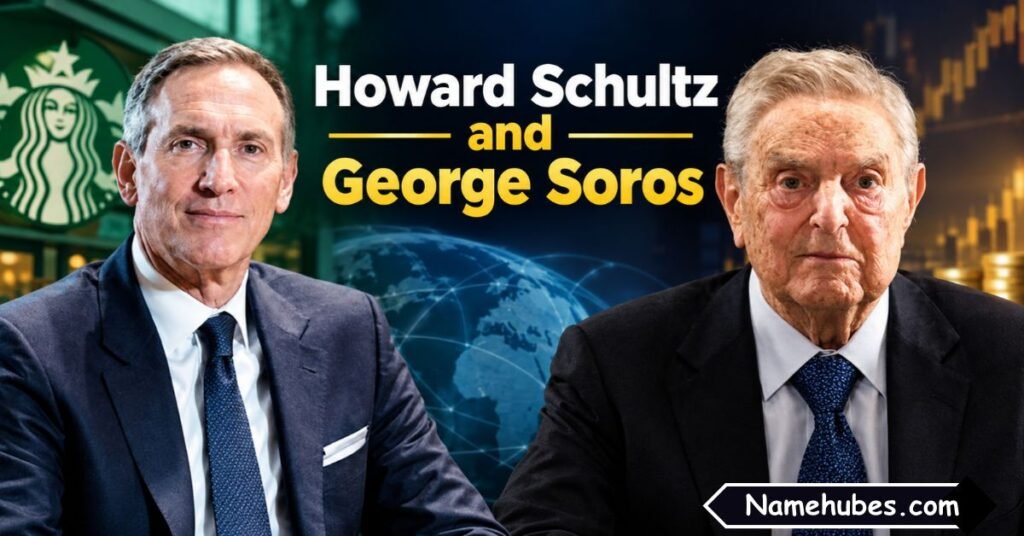
Howard Schultz and George Soros often surface together in online searches about money and politics. Schultz is the Starbucks leader who turned a Seattle coffee shop into a worldwide brand. Soros is the Hungarian-born investor who funded civic causes through the Open Society Foundations. The pairing stems from a 2019 episode.
American Bridge 21st Century, a Democratic-aligned group that Soros had backed, filed a campaign-finance complaint over Schultz’s possible presidential run. The Federal Election Commission closed that case in 2021 without finding a violation. Nothing public shows a business tie or personal friendship. Here is a clear look at their careers, wealth, political roles, and the verified facts connecting them.
Who Is Howard Schultz?
Howard Schultz is an American businessman best known for shaping Starbucks into an international coffeehouse brand. He led the company in two separate stretches and stayed influential long after each exit. His story blends consumer retail, employee policy, and a brief flirtation with national politics.
Early Life and Education
Schultz was born on July 19, 1953, in Brooklyn, New York. He grew up in a working-class family in public housing. His father drove a delivery truck. After the father broke an ankle on the job, the family lost income and health coverage. Schultz often returns to that memory when he talks about economic opportunity and employee benefits.
Football offered a way forward. He earned a scholarship to Northern Michigan University and graduated in 1975 with a degree in communications. A sales career followed, first at Xerox and later at Hammarplast, a Swedish housewares company.
At Hammarplast he noticed something odd. A small Seattle retailer called Starbucks kept ordering large numbers of drip coffee makers. Curiosity pulled him west in 1981.
How Schultz Built Starbucks Into a Global Brand
Schultz joined Starbucks in 1982 as director of retail operations and marketing. At the time the company sold whole beans, tea, and brewing equipment. It did not focus on serving drinks.
A 1983 trip to Milan changed his thinking. Italian espresso bars worked as neighborhood gathering spots where people talked over coffee. He believed American customers would welcome the same atmosphere. The founders hesitated, since they wanted to remain a bean retailer.
Schultz left in 1985 and started his own coffee business, Il Giornale. Two years later he bought Starbucks with the help of local investors and folded his concept into the brand. Growth came fast. The company went public in 1992 and expanded from a regional Seattle chain into a worldwide network of stores.
His second stint as chief executive began in 2008, during a sharp slowdown. He refocused the company on coffee quality and the in-store experience. That turnaround reinforced his reputation as a hands-on brand builder.
His Leadership Style, Employee Benefits, and Business Legacy
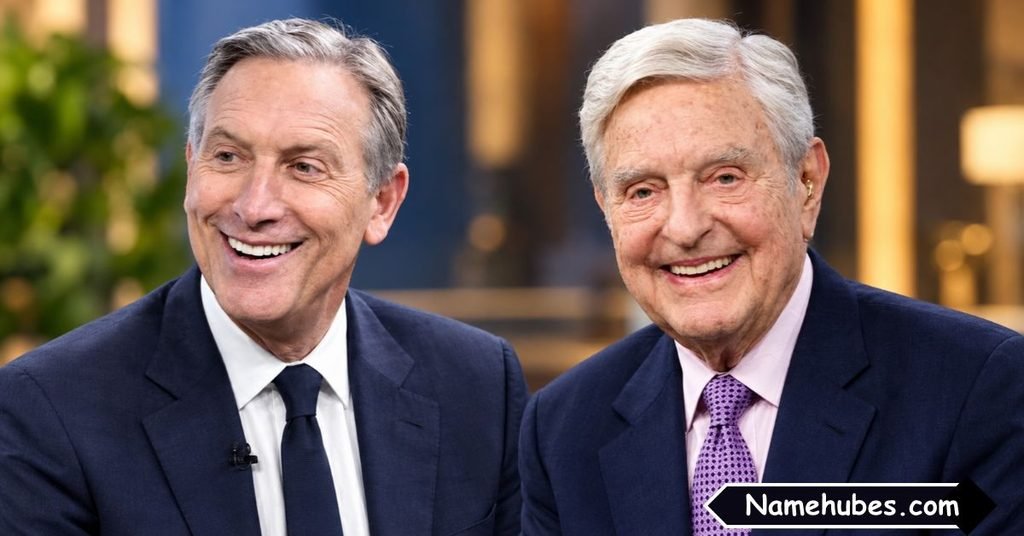
Schultz called employees “partners,” and several programs backed that language. In 1988 Starbucks began offering health coverage to eligible part-time workers, which was unusual in retail. In 1991 it introduced Bean Stock, a stock option plan that gave employees a share in company performance. In 2014 it launched the College Achievement Plan with Arizona State University, which helped eligible workers pursue a degree.
Schultz also pushed the company into social commitments. Starbucks pledged to hire veterans and refugees, and it used its stores as a stage for public conversations.
Not everyone accepts the flattering version. Critics point to wages, unpredictable scheduling, and staffing levels. Union organizing at Starbucks stores began in Buffalo in 2021 and spread nationwide. Those disputes show how employee policies should be judged by results rather than intentions alone. Schultz’s legacy is therefore mixed. He expanded benefits and a global brand. He also left questions about how well the company’s ideals matched daily working conditions.
Why Howard Schultz Stepped Down as Starbucks CEO
Schultz did not leave once. He stepped back several times, each for a different reason.
He first moved from chief executive to chairman in 2000. He returned as chief executive in 2008 to steady the business. In December 2016 he announced he would hand the role to Kevin Johnson in April 2017. Schultz said he wanted to concentrate on innovation, premium Reserve stores, and the company’s social impact. He became executive chairman.
In 2018 he left that role and became chairman emeritus. Speculation about public service followed, and in 2019 he explored an independent presidential run. He returned yet again in March 2022 as interim chief executive after Johnson retired. Laxman Narasimhan took over in 2023, and Schultz left the board in September of that year. Brian Niccol has led the company since September 2024.
Who Is George Soros?
George Soros is a Hungarian-born American investor, author, and philanthropist. He earned his reputation in international financial markets. He later built one of the largest private philanthropic networks in the world through the Open Society Foundations.
Early Life and Education
Soros was born in Budapest, Hungary, in 1930. His childhood unfolded under political upheaval and the Nazi occupation of Hungary during World War II. His Jewish family survived by hiding its identity and using false documents.
He left Hungary in 1947 and settled in London. There he studied at the London School of Economics, where philosopher Karl Popper shaped his thinking. Popper’s idea of the open society, which values free inquiry and limits on power, became a guiding theme for his later work.
Early jobs were modest. Soros later moved to the United States and entered the financial industry. His background gave him a lasting interest in economics, political institutions, and the relationship between individual freedom and government authority.
His Career as an Investor and Financier
Soros started in finance as a young employee at investment firms in London and New York. By 1970 he had launched an investment fund that grew into the Quantum Fund. He gained attention for his approach to currency and global markets, which he explained through a theory he called reflexivity. In short, he argued that investor beliefs can shape market conditions rather than merely react to them.
His best-known trade came in 1992. His fund took a large position against the British pound before the currency was forced out of the European Exchange Rate Mechanism. The bet earned him roughly a billion dollars and a nickname as the man who broke the Bank of England.
That episode made him famous. It also demonstrated how financial markets respond to economic conditions, government decisions, investor expectations, and risk.
Soros’s Investment Activities and Business Interests
Soros’s business life centers on Soros Fund Management. In 2011 he returned money to outside investors, which turned the firm into a family office that manages assets for his family and philanthropic causes. Stanley Druckenmiller, who ran Quantum for much of the 1990s, remains among its best-known alumni.
His business interests are mostly financial. They include market investments, a fund structure that supports philanthropic work, and a growing role for his children in managing the family’s affairs. Unlike a corporate founder, Soros created wealth through investment returns rather than a single consumer product.
The Open Society Foundations and His Philanthropic Work
Soros began his philanthropic activities in 1979 with scholarships for Black South African students living under apartheid. He then expanded his giving across Eastern Europe, where he supported universities, independent media, and civil society groups after the Cold War.
The Open Society Foundations grew into an international network that backs human rights, accountable government, education, independent media, and democratic participation. It reports lifetime giving of more than $32 billion. His son Alex Soros became chair in 2023. In January 2025, Soros received the Presidential Medal of Freedom from President Joe Biden.
His giving has drawn sharp criticism. Opponents often disagree with the policies that some grant recipients support. Supporters argue that independent civil society groups protect rights and public accountability. A fair assessment requires looking at specific grants and outcomes rather than assuming that every funded organization shares identical goals.
Howard Schultz and George Soros: Careers and Public Influence
Both men earned wealth and visibility. They used them in different ways. The contrast clarifies why comparing them directly is less useful than looking at how each shaped public life.
Corporate Leadership Versus Financial Investment

Schultz became known through consumer business leadership. His work centered on retail operations, brand recognition, employee programs, and the growth of a global coffee business. Success depended on store experience, customer habits, and thousands of workplace decisions.
Soros rose through investment management. His career involved reading economic trends, identifying opportunities, and managing risk across currencies and markets. Success depended on timing and judgment rather than on running a company with a large workforce.
Each path carries its own form of influence. A major employer shapes jobs, local economies, and workplace standards. An investor shapes capital flows and, through philanthropy, can later steer funds toward public causes.
Different Approaches to Philanthropy and Social Impact
Schultz’s social impact work runs largely through the company and the Schultz Family Foundation, which he leads with his wife, Sheri Schultz. The foundation supports young people who are not in school or working and helps veterans find employment opportunities. These programs focus on pathways into education and work.
Soros takes a broader, institution-focused approach. The Open Society Foundations fund civil society organizations, researchers, schools, and media outlets, with priorities that vary by country.
Both approaches use private wealth for public purposes. Both raise questions about accountability. Corporate programs can be judged by employee outcomes and business practices. Philanthropic programs can be judged by grant transparency, measurable results, and the independence of recipient organizations.
Is There a Documented Connection Between Howard Schultz and George Soros?
Yes, but only a narrow, indirect one. It runs through a political organization rather than a personal or business relationship.
Schultz’s Consideration of an Independent Presidential Campaign
In early 2019, Schultz announced that he was considering a run for president in the 2020 election as an independent candidate. His name recognition made the idea newsworthy. He described himself as a centrist who was frustrated with both major parties.
Reactions split along familiar lines. Some political observers worried that an independent could draw votes from a Democratic nominee. Others doubted a third-party campaign could build enough nationwide support. Schultz ended the exploration in September 2019 and said he would not run.
American Bridge 21st Century and the Political Complaint
American Bridge 21st Century is a political organization focused on opposition research and on advancing Democratic political objectives. Soros had financially supported it in earlier election cycles.
In 2019, American Bridge filed a complaint with the Federal Election Commission about Schultz’s presidential exploration. The complaint questioned whether his campaign spending and public activity should have triggered candidate registration and reporting requirements.
One distinction matters here. The organization filed the complaint. Soros’s earlier financial support for that group does not, on its own, show that he directed or approved the filing.
The Federal Election Commission later reviewed the matter and closed it in 2021 without establishing the alleged campaign-finance violation. The complaint is best understood as an allegation that an agency examined, not as proof of wrongdoing.
What the Available Evidence Actually Establishes
The public record supports a limited conclusion. The two men are connected indirectly through a political organization that had received financial support from Soros and later filed a complaint concerning Schultz.
The record does not show that they were business partners, relatives, or close personal friends. It does not show a shared commercial venture. It also does not prove that Soros ordered or controlled the complaint.
Readers can test any claim about public figures with a few questions:
- What action was actually documented?
- Which person or organization took that action?
- Is there reliable evidence of direct involvement?
- Was the allegation investigated, dismissed, or substantiated?
- Does the conclusion rest on official records or on assumptions about associations?
These checks separate legitimate scrutiny from speculation. A donor’s contribution is relevant information. Assigning responsibility for a specific decision requires additional evidence that links the donor to it.
Howard Schultz and George Soros: Wealth and Financial Influence
Wealth shapes how both men are discussed. Estimates vary widely by source, so any figure deserves caution.
| Discover More Celebrities |
| Zach Bryan Bio: Age, Height, Wife, Family & Net Worth 2026 |
| Wayne Gretzky and Miguel Patricio: Careers and Connection |
| BigXthaPlug Age, Real Name, Height & Net Worth (2026) |
How Their Sources of Wealth Differ
Schultz’s fortune grew mainly from his equity stake in Starbucks and compensation tied to its expansion. Soros’s fortune came from investment returns earned through decades of market trading, with later wealth held in a family office.
| Area | Howard Schultz | George Soros |
| Main source of wealth | Starbucks equity and leadership compensation | Investment returns and fund management |
| Type of career | Business leadership | Financial investment |
| Philanthropic vehicle | Schultz Family Foundation | Open Society Foundations |
| Typical public estimate | A few billion dollars | Roughly single-digit billions, depending on the source |
Who Is Richer: George Soros or Elon Musk?
Elon Musk is far richer. Forbes ranked him first on its 2026 World’s Billionaires List with a net worth of about $839 billion in March 2026. Estimates for Soros in 2026 sit in the single-digit billions, with figures near $7 billion to $9 billion depending on the source.
The gap partly reflects how each man handled his money. Soros has given a large share of his wealth to the Open Society Foundations. Musk’s fortune is tied mostly to equity in companies whose valuations have climbed sharply. Both measures are estimates that move with markets.
Political Influence and Public Controversies
Political activity has shaped how both men are viewed. Their roles differ in scale and in style.
Schultz’s Political Positions and Presidential Ambitions
Schultz has long identified with the Democratic side on many social questions. By 2019 he described himself as a centrist independent. He voiced concern about the national debt and criticized proposals such as a wealth tax and a government-run health insurance system as unrealistic. He argued that both major parties had failed to solve big problems.
The reaction was loud. Some Democrats feared he would help reelect the incumbent. Others dismissed him as out of touch with ordinary voters. Social media campaigns even urged people to boycott Starbucks. Schultz withdrew in September 2019 and returned to business life.
Soros’s Political Donations and Public Advocacy
Soros has been one of the most visible donors in American politics. He has backed Democratic candidates and committees, and he has funded advocacy groups and initiatives on criminal justice, voting access, and other issues. His donations since the early 2000s helped establish him as a major political donor.
Abroad, he has funded groups that promote democratic participation and independent institutions. In Hungary, his foundations and the Central European University he founded became targets of government criticism.
Public debate around him is intense. Critics object to the size of his donations and to the causes he supports. Some attacks go further and rely on conspiracy theories that falsely portray him as the hidden hand behind unrelated events. A responsible discussion relies on documented grants, filings, and results.
Does the Starbucks CEO’s Political Position Reflect the Company?
Not automatically. A chief executive’s personal views and a corporation’s formal positions are not the same thing.
Starbucks is a publicly traded company with a board, shareholders, and a leadership team. Its statements come from the company. Its leaders can also speak as private individuals. Today the chief executive is Brian Niccol, and Schultz left the board in 2023. His past political views therefore do not represent the company’s current stance.
History shows the overlap can still be confusing. At a 2013 shareholder meeting, Schultz defended the company’s support for marriage equality and told one critic he was free to sell his shares. In 2017, Starbucks announced plans to hire refugees. Those were company decisions that reflected the leadership’s values at the time. Customers who want to understand a company’s position should look at its official policies and public statements rather than relying on any one executive’s personal politics.
Conclusion
Howard Schultz and George Soros built their fame in different fields. Schultz grew Starbucks into a global coffeehouse brand and introduced employee benefits. Soros earned his wealth in financial markets and funded human rights, education, and civil society through the Open Society Foundations. Their wealth, philanthropy, and politics differ widely.
The only documented link involves American Bridge 21st Century. Soros had supported the group before it filed a 2019 campaign-finance complaint against Schultz. The Federal Election Commission closed the matter in 2021 without establishing a violation. The record shows only an indirect connection, not a business partnership or close friendship.
