

Will your daughter share her name with three other girls in her class?
Will your son turn his head at every “Hey!” in the park because four boys answer to the same name?
That worry sends many parents in the United Kingdom hunting for rare baby names.
You want something real and warm, not a name that needs a spelling lesson at every school gate.
This guide gives you 72 uncommon names you can actually picture on a birth certificate.
You’ll learn what makes a name rare, how to read official UK birth records, and why Welsh and Cornish names deserve a closer look.
You’ll also get simple tests to run before you commit.
Ready to find a name that’s uncommon but never awkward? 👶
What Makes a Baby Name Rare in the UK?
Rare doesn’t mean weird.
A rare name appears infrequently in UK birth records.
Most people still know how to say it and can spell it after seeing it once.
Three checks help you spot the sweet spot:
- Low national usage: The name falls well outside the top rankings and shows up a small number of times each year.
- Established origin: It has real roots in Welsh, Cornish, Latin, Greek, French or another tradition.
- Clear meaning: You can explain it in one breath.
Rarity also depends on location.
A Welsh name might fill playgrounds in Cardiff and barely register in Kent.
That’s how a name can be rare across most of the UK yet feel ordinary to a family in Gwynedd.
Rare isn’t permanent either.
Some names never became widely used, while others sit quietly for decades and then jump after a TV drama.
So check fresh numbers before you fall in love.
Rare Girl Names UK Parents Are Starting to Notice
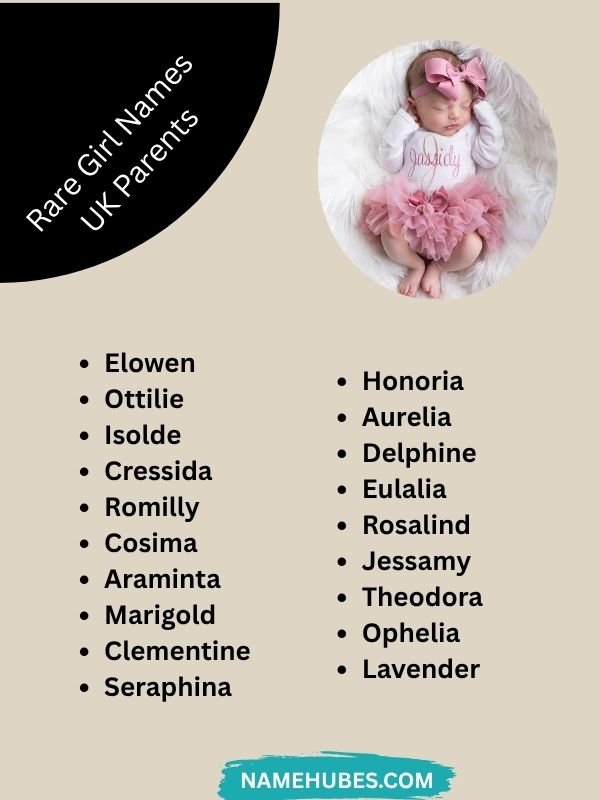
These 18 lean on Welsh, Cornish, Dutch, French, Greek and Latin roots.
Think of them as names parents are quietly choosing right now.
| Name | Meaning |
| Mali | Beloved or jasmine flower |
| Cadi | Welsh pet form of Catherine; short and cheerful |
| Mabli | Welsh version of Mabel; sweet and vintage |
| Eleri | Welsh; soft and flowing sound |
| Gwenllian | Welsh name of a 12th-century princess who fought the Normans |
| Anouk | Dutch and French pet form of Anna |
| Alethea | Truth |
| Calla | Calla lily |
| Delphine | French; tied to the ancient Greek town of Delphi |
| Fenella | White shoulder |
| Isolde | Heroine of a Celtic love legend set partly in Cornwall |
| Morwenna | Maiden |
| Demelza | Cornish place name |
| Lowenna | Joy |
| Branwen | Beautiful raven |
| Ottoline | Old British society name |
| Saskia | Dutch name; associated with Rembrandt’s wife |
| Perpetua | Constant |
📸 Visual idea: A simple UK map showing where Welsh and Cornish names are used most. Caption: Rare baby names UK families choose, mapped by region.
Also Read : Baby Names That Mean Hope: 150+ Girls, Boys & Unisex Names
Rare Boy Names UK Parents Are Starting to Notice
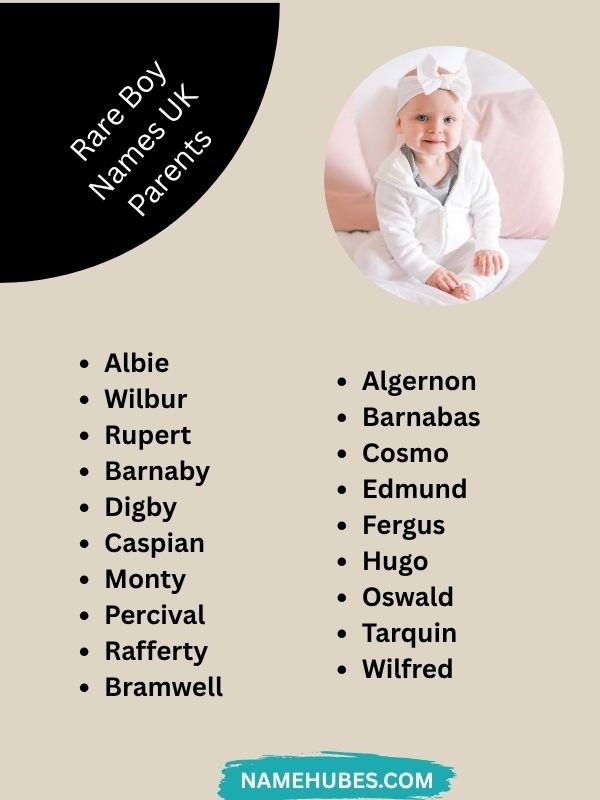
These boy names lean Welsh, Cornish and Latin.
Some sound sturdy.
Others sound like a poet who owns a boat.
- Osian: Ranked tenth for boys in Wales in 2025 but missed England’s top 100.
- Macsen: Welsh form of Maximus, from a Roman-era ruler of Britain.
- Emrys: Welsh name tied to Merlin’s Welsh title, Myrddin Emrys.
- Tomos: The Welsh way to say Thomas.
- Gruffydd: Worn by medieval Welsh princes.
- Ambrose: Greek for “immortal,” borne by a fourth-century saint.
- Cassian: Latin, from a Roman family name.
- Cosmo: Greek roots meaning “order” and “universe.”
- Florian: Latin for “flowering,” and a saint’s name across Europe.
- Idris: Welsh, linked to the mountain Cadair Idris.
- Jago: Cornish form of James.
- Trystan: Cornish and Arthurian knight spelling.
- Caradoc: Old British name of a leader who resisted Rome.
- Hywel: Name of Hywel Dda, the tenth-century king known for Welsh law.
- Peregrine: Latin for “traveler,” and a fast falcon too.
- Casimir: Central European royal name, rare in Britain.
- Gethin: Welsh for “dark.”
- Ludovic: Latin roots, same family as Louis.
Also Read : 60+ Baby Girl Names That Start With Z (With Meanings)
Rare Unisex Baby Names UK Parents Are Choosing
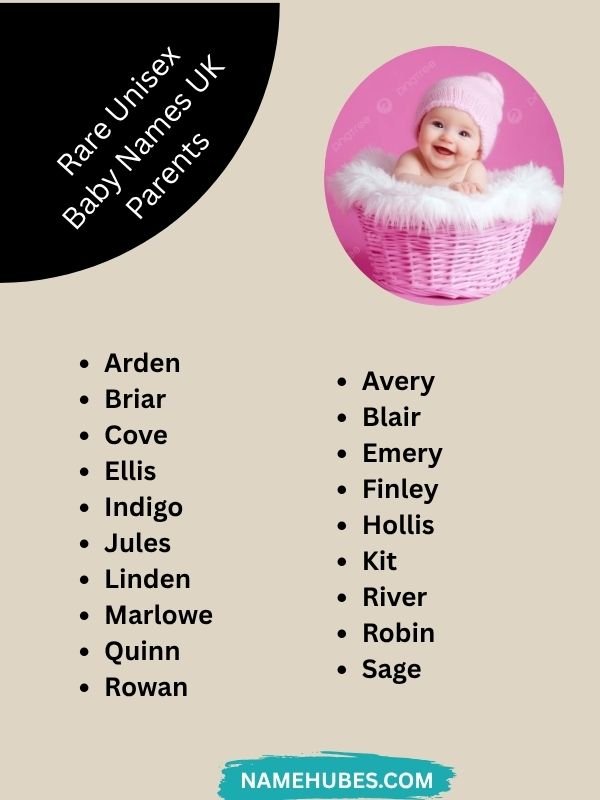
Want a name that fits any baby?
These 18 borrow from British places, plants and birds.
- Arden: From the Forest of Arden in Shakespeare’s As You Like It.
- Blythe: Old English for “cheerful.”
- Emlyn: Welsh place name from west Wales.
- Marlow: English place name, from the town on the Thames.
- Sorrel: A leafy herb and a reddish-brown color.
- Linden: A tree name with a gentle sound.
- Lark: A songbird you might hear over British fields.
- Merritt: English surname turned first name.
- Gwyn: Welsh for “white” or “blessed.”
- Fenn: A nod to the Fens and their wide wetlands.
- Hollis: Surname for someone who lived near holly trees.
- Winslow: English place name from Buckinghamshire.
- Ashby: Place name meaning “ash tree farm.”
- Sennen: Cornish village and cove near Land’s End.
- Perran: Cornish saint name, and think of Perranporth’s beaches.
- Rue: A short plant name that also means regret, so read that twice. 😄
- Tarn: Lake District word for a small mountain lake.
- Vesper: Latin for “evening.”
Also Read : French Girl Names: 185+ Beautiful, Classic & Unique Ideas
Rare Baby Names by Meaning and Origin
Names with a story stick better.
The origin sits in brackets after each one.
| Name | Meaning |
| Lysander | Liberator |
| Benedick | Blessed |
| Portia | Pig, hog, or offering |
| Cordelia | Jewel of the sea |
| Septimus | Seventh |
| Aurelia | Golden |
| Xanthe | Golden-yellow |
| Phaedra | Bright |
| Odette | Wealthy or fortunate |
| Gaspard | Treasure keeper |
| Floris | Flourishing |
| Mieke | Who is like God |
| Sorcha | Brightness |
| Cathal | Battle ruler |
| Taliesin | Radiant brow |
| Cerridwen | Blessed poetry or fair and blessed |
| Gawain | Hawk of battle |
| Percival | One who pierces the valley |
Why Do These Baby Names Feel Rare in the UK?
Short answer: history and geography.
British naming history has layers.
Celtic languages like Welsh, Cornish and Gaelic shaped regional traditions long before English took over daily life.
Later, Norman, Church and European naming history added French, Dutch, Latin and Greek favorites.
Many of these names stayed local.
A Welsh tradition of using them lives on through regular use within Wales, but wider adoption across England and Scotland never followed.
Cornwall did the same with its own words and saints.
Other picks come from older British or European usage and faded after their big moment.
Mainstream naming cycles play a part too.
Parents copy what they hear in nurseries, TV shows and celebrity news.
A name that misses those channels stays uncommon in schools for years.
Plenty of names remain uncommon for many years simply because nobody famous picked them yet.
Watch for the swing, though.
Names near the edge of the chart can climb fast, and short trends can turn a rare name into a common one.
Look at the trend line, not just today’s rank.
How to Choose a Rare Name That Fits Your Family
When does a rare name make sense?
It works best when you want individuality without repetition and a choice that feels personal and considered.
It also helps if your surname is very common and you want balance.
It’s a tougher fit if you dislike explaining things, since some Welsh spellings need a quick pronunciation lesson.
Try these personal touches:
- Honor family roots. Pick a Welsh or Cornish name if a grandparent grew up there.
- Pair it with your surname. Say the full name aloud and listen for clashing sounds or rhymes.
- Build a middle-name bridge. Put a rare pick first with a familiar middle name, or flip them.
- Choose a meaning you love. “Joy” or “truth” tells a better story than “it sounded nice.”
- Plan for nicknames. Every long name breeds a short one, so pick one you can live with.
How to Test a Rare Baby Name Before You Commit
Give the name a proper trial run.
- The coffee-shop test: Give the name at the counter and count how often you spell it.
- The shout test: Call it across a park to see if it carries.
- The form test: Type it into an email address and a school form.
- The initials test: Check the full initials for unfortunate words.
- The two-week test: Use it on the bump for two weeks and see if you still smile.
Then hand the written name to three people and ask them to read it aloud.
Their guesses show you what teachers, doctors and coworkers will say.
Clear pronunciation and familiar spelling patterns make life easier in classrooms, workplaces, and formal settings.
Tips for Making a Rare Name Work in Everyday British Life
A rare name settles in fast with a little help.
- Share a pronunciation trick early. A rhyme or a “sounds like” phrase saves years of repeating yourself.
- Keep spelling consistent. Use the same version on medical records, school lists and passports.
- Skip creative respellings. They break familiar spelling patterns and create endless correcting.
- Tell the story. Kids love explaining where their name comes from, and it turns “How do you say that?” into a chat.
- Add a friendly short form. A nickname keeps a long, old name light.
Everyday British life is full of surnames and place names that once sounded unusual.
A well-chosen rare name blends in faster than you’d expect.
Frequently Asked Questions About Rare Baby Names in the UK
What counts as a rare baby name in the UK?
A name that appears only a few times a year in UK birth records and sits far outside the top rankings.
It should still have a clear origin, meaning and spelling.
Are Welsh baby names rare across the rest of the UK?
Mostly yes.
The 2025 ONS data shows some Welsh favorites ranking high in Wales while missing England’s top 100.
Do rare baby names stay rare over time?
Not always.
A TV show or a famous baby can push a name up fast, so check the newest ONS release before you decide.
Are rare baby names harder to spell or pronounce?
Sometimes.
Welsh names use letter patterns English speakers don’t expect, but a short pronunciation tip fixes most trouble.
Can a rare baby name work in everyday British life?
Yes.
Teachers, doctors and employers meet new names all the time, and clear sounds plus a normal spelling help a lot.
Why do parents search for rare baby names instead of popular ones?
Most want a name that feels personal.
They want fewer name twins at school and a story to tell.
Finding Your Rare Baby Name
Rare baby names let you stand out without sounding strange.
You’ve seen what makes a name rare, how to read UK birth records, and how Welsh tradition, Cornish tradition and European naming history shape 72 fresh options.
You’ve also got clear tests and personal touches to help you decide.
The big lesson? Choose a name with a clear meaning, a familiar spelling, and a story you’ll enjoy telling for years.
Now it’s your turn.
Read your top three aloud, sleep on them, and see which one still feels like home.
Which name caught your eye first?
Tell us in the comments, and share this list with a partner or friend who’s deep in the name hunt.
Rankings shift every year, so check back after each new ONS release. 💛
