

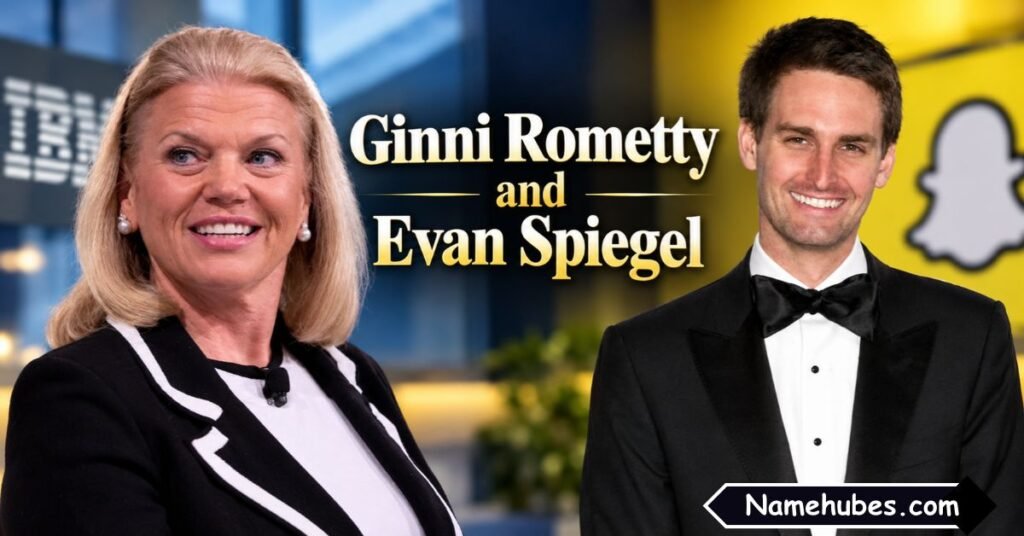
Two leaders, two very different playbooks. Ginni Rometty and Evan Spiegel share one documented link: membership in the Aspen Economic Strategy Group, which welcomed Spiegel on February 10, 2026. Rometty joined IBM in 1981 and rose to chairman, president and CEO. Spiegel cofounded Snapchat at Stanford and now runs Snap Inc. and Specs Inc. They aren’t related and haven’t announced a joint venture.
Their paths never crossed on any project but contrast teaches plenty. Still, their careers show how enterprise technology and consumer technology demand different instincts. You’ll see who each leader is, what each built, what happened at Snap in 2026, and what business leaders can borrow from both.
Ginni Rometty and Evan Spiegel: Quick Facts
| Detail | Ginni Rometty | Evan Spiegel |
| Full name | Virginia M. Rometty | Evan Thomas Spiegel |
| Known for | Former chairman, president and CEO of IBM | Cofounder and CEO of Snap Inc. and Specs Inc. |
| Born | July 29, 1957, Chicago | June 4, 1990, Los Angeles |
| Education | Northwestern University, computer science and electrical engineering, 1979 | Stanford University, BS in Engineering, Product Design |
| Career start | IBM systems engineer, Detroit office, 1981 | Created Snapchat at Stanford with Bobby Murphy |
| Current focus | SkillsRight cochair, corporate boards, Teneo senior advisor | Running Snap Inc. and Specs Inc. |
| Shared link | Aspen Economic Strategy Group | Joined the Aspen Economic Strategy Group in February 2026 |
What Connects Ginni Rometty and Evan Spiegel?
A single membership ties these two names together. Everything else in their stories runs on separate tracks.
The Aspen Economic Strategy Group and Their Professional Overlap
Picture a roundtable where economists, executives, and former policymakers hash out the country’s toughest money problems. That’s the Aspen Economic Strategy Group, usually shortened to AESG. It’s a nonprofit program of the Aspen Institute, a bipartisan body focused on evidence-based answers to major U.S. economic challenges. It began in 2017 and caps membership at 65 people. Former Treasury Secretaries Henry Paulson and Timothy Geithner serve as co-chairs.
The AESG announced Spiegel as a new member on February 10, 2026. He joined alongside Patrick Collison of Stripe, Gita Gopinath of Harvard, and Peter Orszag of Lazard.
Rometty already has a profile on the AESG site. It describes her as former chairman, president and CEO of IBM and co-chair of SkillsRight. It also lists her board roles at JPMorgan Chase, Cargill, Memorial Sloan Kettering Cancer Center, and the Brookings Institution. Public listings don’t state the year she joined.
Their Connection to the Business Roundtable
Some links hide in plain sight. Spiegel belongs to the Business Roundtable, an association of corporate leaders. IBM credits Rometty’s work with the same group for helping redefine the purpose of the corporation.
Does that mean they served together? Nothing in the available record says so. Treat it as a shared professional circle and not a shared project.
Are They Collaborators, Business Partners, or Simply Industry Peers?
Industry peers is the honest label. Announcements and member listings show no joint company, product, or public appearance by the two of them. A shared membership isn’t a partnership.
They’re also not related. No reliable public source reports any family relationship. If you want to verify the membership yourself, the AESG members page lists both names.
Who Is Ginni Rometty?
Few executives have steered a technology giant through as much change. Virginia M. Rometty did it from the corner office at IBM.
Early Life and Educational Background
Rometty was born in Chicago on July 29, 1957. She was the eldest of four children in an Italian American family. A General Motors scholarship carried her to Northwestern University, where she graduated with high honors in 1979 with a degree in computer science and electrical engineering.
Her memoir shapes the picture of those years. In Good Power, she describes how her father left the family when she was a teenager and how her mother worked to hold things together.
Her Career Journey and Rise at IBM
Every big career has a first rung. Hers was a job as an IBM systems engineer in the company’s Detroit office in 1981.
From there she moved through technical, consulting, sales, and strategy roles. She also held senior leadership responsibilities at IBM Global Services and IBM Global Business Services. One defining assignment was leading the integration of PricewaterhouseCoopers Consulting into IBM. That deal created a global team of more than 100,000 consultants and services experts.
She became IBM’s CEO in January 2012 and was the first woman to lead the company. She retired on December 31, 2020. Arvind Krishna succeeded her and is IBM’s current chairman and CEO.
Ginni Rometty’s Leadership and Legacy at IBM
Reinvention was the job description. IBM credits her tenure with these milestones:
- 65 acquisitions, including Red Hat, the largest in IBM’s history
- About half of the company’s portfolio reinvented
- A $25 billion hybrid cloud business, plus a push into artificial intelligence and quantum computing
- The P-TECH program, which expanded to more than twenty-eight countries
- A role in redefining the purpose of the corporation through the Business Roundtable
Some terms deserve a plain explanation. Hybrid cloud computing lets organizations blend private infrastructure with public cloud services. That helps them manage applications, data, and security across different environments. IBM completed its roughly $34 billion Red Hat acquisition in 2019, adding enterprise open-source expertise to that strategy. P-TECH pairs secondary education with college-level learning and career preparation, so it links technology education to real jobs.
The reinvention wasn’t painless. IBM’s revenue fell 5% to $99.8 billion in fiscal 2013. By late 2014 the company faced a twelfth straight quarter of declining sales. Rometty argued that real growth requires leaving your comfort zone, and those middle years put that belief to a very public test. Selling businesses and redirecting money toward growth areas is never comfortable.
Her Work and Initiatives After Leaving IBM
Retirement didn’t slow her down. Her focus since 2020 has centered on jobs and governance.
In 2020 she cofounded OneTen, a coalition aiming to hire and promote one million Black Americans without four-year degrees into family-sustaining careers by 2030. On April 9, 2026, OneTen announced it was evolving into SkillsRight. Rometty and Kenneth Frazier serve as co-chairs. The new name signals a shift from rallying employers to giving them data, tools, and implementation help for skills-first hiring. That’s workforce development with a practical edge.
Her board work grew too. She joined the JPMorgan Chase board in 2020 and the Cargill board in 2022. She has also served as a senior advisor at Teneo. And she wrote Good Power, a bestseller published by Harvard Business Review Press.
Awards, Recognition, and Professional Achievements
Recognition followed the results. Fortune ranked her the most powerful woman in business three years in a row. She is an Officer of France’s Légion d’Honneur and a member of the National Academy of Engineering. Northwestern awarded her an honorary degree in 2015 and invited her to deliver that year’s commencement address.
Who Is Evan Spiegel?
Some founders build products. Spiegel built a habit. Snapchat changed how younger users message each other.
Early Life and Education at Stanford
Spiegel was born in Los Angeles on June 4, 1990. He earned a BS in Engineering, Product Design at Stanford University. There he and Bobby Murphy created Snapchat.
Founding Snapchat and Building Snap Inc.
The idea was simple and bold. Photos and videos would disappear after viewing, which set the service apart from networks built around permanent posts and public profiles.
Spiegel became a billionaire at 25 and famously turned down buyout offers from Mark Zuckerberg. Snap went public in 2017 at $17 per share. The stock closed its first trading day up 44 percent. Spiegel and Murphy built the business into a company with advertising products, augmented reality tools, and creator features far beyond the first messaging app.
Evan Spiegel’s Leadership as Snap’s CEO
Leading a public company is a different sport from founding one. Spiegel has served as Snap’s CEO since May 2012, and today he’s CEO of both Snap Inc. and Specs Inc. Snap’s August 2026 earnings release quotes him as cofounder and CEO.
This year has tested him. The table below summarizes Snap’s first two quarters of 2026, drawn from the company’s filings.
| Metric | Q1 2026 | Q2 2026 |
| Revenue | $1,528.8 million, up 12% | $1,599.0 million, up 19% |
| Daily active users | 483 million | 493 million |
| Monthly active users | 956 million | 971 million |
| Net loss | $89.0 million | $164.0 million |
| Free cash flow | $286.0 million | $120.5 million |
Revenue and users climbed while the net loss widened and free cash flow dropped. That tension sits at the heart of Snap’s financial performance story. In Q2, average revenue per user rose to $3.25 from $2.87 a year earlier. Advertising revenue grew 9% to $1.28 billion. Other revenue, which includes the Snapchat+ subscription, jumped 85% to $316 million. The soft spot is North America, where daily users fell 7% to 92 million. For Q3, Snap forecast revenue of $1.7 billion to $1.74 billion.
Investor pressure arrived in March. On March 31, 2026, Irenic Capital Management sent Spiegel a public letter. The firm holds about 2.5% of Snap’s Class A shares. It laid out a path to $26.37 per share while the stock traded at $3.93, and the shares rose 14% that day. Irenic urged Snap to shut down or spin off Specs, cut about 1,000 jobs, and give Class A shareholders one vote per share. Snap’s chairman responded that the company welcomes input from all shareholders.
Then came the April 15 restructuring. Snap announced a 16% workforce reduction, roughly 1,000 people, and closed more than 300 open roles. The plan targeted over $500 million in annualized savings by the second half of 2026 and carried $128.5 million in restructuring charges. Snap now names free cash flow per share as its primary financial goal.
Philanthropy and Work Beyond Snapchat
Giving back runs through his story. In 2017 he formed the Spiegel Family Fund. With Murphy, he created the Snap Foundation, which builds pathways into the creative economy for young people in Los Angeles who are underrepresented in it. After the Los Angeles wildfires destroyed his childhood home, he cofounded the Department of Angels, a nonprofit supporting fire-affected residents.
On October 13, 2026, he was honored at the George H.W. Bush Points of Light Awards. People reported that he and his wife, Miranda Kerr, helped erase $550 million in medical debt for more than 261,000 Californians. His family fund also helped launch a long-term study of the wildfires’ health effects. The couple married in May 2017, and his AESG biography says they have four children.
His board and council roles stretch further. He serves on the boards of the Berggruen Institute and Crossroads School for Arts and Sciences. He also belongs to the Business Roundtable, the Business Council, and the CalCEO Council’s Executive Committee. In February 2026 he published a Financial Times op-ed calling Australia’s social media ban a high-stakes experiment.
Evan Spiegel’s Vision for Snap and Augmented Reality
Spiegel doesn’t want Snap to stay a messaging app. He’s betting on a future where the camera sits on your face.
Snapchat’s Evolution Beyond Social Media
Think of Snapchat as a camera first and a network second. Over time the platform added Stories, camera filters, augmented reality lenses, and tools for talking with friends. Those features made the camera central to the experience. Snap also built mobile-first advertising products so businesses could reach audiences through visual formats.
Revenue now tells a bigger story. The Snapchat+ subscription helped push other revenue up 85% in Q2. Snap leans harder on subscriptions and direct revenue instead of depending on ads alone. That move reflects a broader shift from a pure social media platform toward a diversified digital communication business.
Augmented Reality and the Future of Smart Glasses
Augmented reality layers digital elements onto your view of the physical world. Specs, Snap’s AR glasses, are Spiegel’s biggest bet. In 2026 Snap established Specs Inc. as a distinct subsidiary, which shows how seriously the company takes the project.
The rollout hasn’t been smooth. TechCrunch reported that the June reveal drew jeers online and calls for him to resign, and the stock fell afterward. Snap answered at a September 16 event in Los Angeles by introducing SPECS Intelligence, an anticipatory AI service designed to work across iPhone, Mac, and the glasses. The event also brought new AR experiences for entertainment, work, shopping, translation, and navigation, plus a charging case with cellular.
If you’re thinking of buying a pair, here’s what the sources confirm:
- The price is $2,195
- Preorders opened on June 16 with a $200 refundable deposit
- Shipping is expected this fall in the United States, United Kingdom, and France
- Snap hasn’t given a specific delivery date in the reporting reviewed
Reviewers have flagged the heavy frame and short battery life as trade-offs at this price. Trying a pair before you commit is sensible.
On October 20, 2026, Snap announced that Robert Downey Jr. joined Specs as honorary Chief Customer Experience Officer. He will help develop original content, Lens experiences, and hardware collaborations. The partnership made its broadcast debut during the Knicks and 76ers game. The move shows Snap wants Specs to feel like entertainment and not just enterprise hardware.
Snap’s Long-Term Technology and Innovation Strategy
Big bets need big partners. Snap is working with Nvidia, Amazon Web Services, and Salesforce to bring Specs to businesses. That points to a long-term plan that reaches past consumers.
Artificial intelligence plays two roles in the plan. It’s a product feature through SPECS Intelligence. It’s also a way to run the company with fewer people after the April cuts. The open question is whether cost savings reach profit and whether enough people will pay $2,195 for the glasses. Long-term business growth depends on both answers.
Ginni Rometty and Evan Spiegel: Comparing Their Leadership Styles
Same industry label, very different jobs. Rometty led a corporation with decades of history, a broad enterprise customer base, and complex global operations. Spiegel built and still leads a company tied closely to consumer communication and digital product innovation. Their leadership styles reflect those starting points.
Corporate Transformation vs. Entrepreneurial Leadership
Rometty’s task was reinvention without a blank page. IBM already had customers, employees, and revenue built over a century. She had to steer it toward cloud and AI while older lines shrank. Acquisitions such as Red Hat were her main tools.
Spiegel’s task runs the other way. He built the product, and now he’s defending it while an activist investor questions its costs and governance. His 2026 decisions show a founder adapting to pressure while holding on to his product vision. He cut about 16% of staff and made free cash flow his top financial goal.
Neither path is easier. One leader has to change something that already works. The other has to keep something young from breaking.
Decision-Making, Innovation, and Business Growth
Watch how each leader spends money. Rometty made large portfolio calls: buying companies, divesting others, and shifting resources toward hybrid cloud, AI, and quantum computing. Her decisions moved slowly because a global enterprise can’t turn on a dime.
Spiegel’s calls center on product and user behavior. He keeps betting on cameras, lenses, and now glasses. Yet public company status adds a second voice to every decision, and that voice belongs to shareholders. Each leader balances immediate business needs against longer-term objectives. They simply do it in different arenas.
| Also Read This Celebs |
| Anthony Hopkins and George Clooney: Careers and Life Stories |
| Tyra Banks and Greg Hayes: Careers and Personal Life |
| Lachlan Murdoch and David Cordani: What Connects Them? |
Enterprise Technology vs. Consumer Technology: Their Different Approaches to Innovation
Who pays the bill shapes what gets built. IBM under Rometty sold to businesses, so innovation meant security, hybrid cloud, data, and AI services that large organizations could trust. Trust and reliability mattered more than flash.
Snap sells attention to advertisers and subscriptions to users. Its innovation is visible and personal: lenses, Spotlight, and now glasses. Users judge it in seconds by whether it feels fun and useful.
| Area | Ginni Rometty | Evan Spiegel |
| Path to the top | Rose through IBM over decades | Cofounded the company at Stanford |
| Type of company | Enterprise technology and services | Consumer social platform and AR hardware |
| Core technology | Hybrid cloud, AI, quantum, security | Camera messaging, AR glasses, AI |
| Current role | SkillsRight cochair, board member, senior advisor | CEO of Snap Inc. and Specs Inc. |
| 2026 storyline | OneTen becomes SkillsRight | Activist pressure, layoffs, Specs launch |
Their Influence on the Technology Industry
Impact comes in two flavors here: deep inside corporations and out in the hands of millions of users.
Ginni Rometty’s Impact on Enterprise Technology and Artificial Intelligence
Rometty pushed a century-old giant toward the technologies that now define enterprise computing. Hybrid cloud, AI, security, and quantum computing all sat on her agenda. These areas still shape how organizations manage information and modernize operations.
Her influence reaches people too. P-TECH linked schools with employers, and OneTen and SkillsRight carry the skills-first hiring idea forward. Few technology leaders have tied corporate strategy to workforce development so tightly.
Evan Spiegel’s Influence on Social Media and Digital Experiences
Spiegel helped popularize messaging that feels informal and temporary. Snapchat showed that a camera could be the center of a social product. Its lenses and filters made augmented reality familiar long before smart glasses reached shoppers.
His influence now stretches into policy conversations too. His Financial Times op-ed on Australia’s social media ban shows he’ll weigh in on how platforms meet society. Questions about privacy, responsible data use, and digital well-being keep growing as technology moves deeper into daily life.
What Leaders Can Learn From Ginni Rometty and Evan Spiegel
Four lessons stand out from two very different careers:
- Stay long enough to understand the machine. Rometty’s decades inside IBM gave her the knowledge to change it.
- Growth alone doesn’t end the argument. Snap’s user numbers rose in 2026 yet investors pressed on cash flow, governance, and focus.
- Adapt before the market forces you. IBM adjusted its portfolio as enterprise computing shifted. Snap keeps exploring revenue beyond its original messaging service.
- Pick your priorities. Resources are limited, so every market and technology choice carries risk.
Both stories ask the same question: how do you keep people employable while technology changes how work gets done? Leadership responsibilities also change as businesses grow. Building a product, running an established corporation, and answering to public shareholders each call for different skills.
Conclusion
Ginni Rometty and Evan Spiegel share one documented link: the Aspen Economic Strategy Group. Spiegel joined in February 2026. They aren’t related and haven’t built anything together. Rometty spent nearly four decades at IBM, steering it toward hybrid cloud, AI, and the Red Hat deal. Today she cochairs SkillsRight.
Spiegel took the opposite route. He cofounded Snapchat at Stanford and now leads Snap Inc. and Specs Inc. through investor pressure, layoffs, and a costly bet on AR glasses. One leader transformed an institution. The other is still proving a young company can reinvent itself. Their contrast offers the real lesson.
Frequently Asked Questions
Are Ginni Rometty and Evan Spiegel related?
No. They share membership in a policy group and have no family ties. No reliable public source reports any family relationship between them.
What connects Ginni Rometty and Evan Spiegel?
Both are listed members of the Aspen Economic Strategy Group, a bipartisan group focused on U.S. economic policy. Spiegel joined in February 2026. Both also have ties to the Business Roundtable, though nothing shows they served at the same time.
Have Ginni Rometty and Evan Spiegel ever worked together?
Not on any publicly announced project. The documented overlap is their membership in the Aspen Economic Strategy Group.
Is Evan Spiegel still the CEO of Snap?
Yes. Snap’s August 2026 earnings release quotes him as cofounder and CEO. He also leads Specs Inc.
Is Ginni Rometty still associated with IBM?
No. She retired from IBM on December 31, 2020. Arvind Krishna now serves as chairman and CEO.
What is the Aspen Economic Strategy Group?
It’s a nonprofit program of the Aspen Institute that brings business executives, academic economists, and former policymakers together. The group is bipartisan and works on evidence-based answers to major U.S. economic challenges. It was established in 2017 and caps membership at 65 people. Henry Paulson and Timothy Geithner serve as co-chairs.
What is Ginni Rometty doing after IBM?
She cochairs SkillsRight with Kenneth Frazier. The organization grew out of OneTen, which she cofounded in 2020. She also serves on the JPMorgan Chase and Cargill boards, has served as a senior advisor at Teneo, and wrote Good Power.
What is Evan Spiegel’s role in augmented reality technology?
He leads Snap’s push into AR as CEO of both Snap Inc. and Specs Inc. Specs are Snap’s AR glasses, priced at $2,195. Snap also introduced SPECS Intelligence, an AI service built to work across iPhone, Mac, and the glasses.
What are Ginni Rometty and Evan Spiegel’s net worths?
Published estimates vary widely from site to site, so no unverified figure appears here. Spiegel’s wealth ties closely to Snap’s share price, so any estimate moves with it. Check Forbes or Bloomberg for a current, dated number.
